Emily Keefer was a participant with the Alamosa, Colorado, Mennonite Voluntary Service (MVS) unit, and recently completed her two-year term. This post was originally published on her blog, and has been edited here for length. Click here to read her blog in full. Mennonite Voluntary Service is a one-year service experience of Mennonite Mission Network for individuals age 20+, with the opportunity for a placement extension for an additional one to two years. Applications for the 2026-27 service term are open! Click here for more information and to apply.
When I arrived in Alamosa, Colorado, I hoped that leaving would be painful. This may seem a masochistic sentiment, but as a well-practiced leaver, this is the best way I can describe an effective or meaningful time somewhere. If you have really grown roots or tendrils in a place, the removal should hurt some.
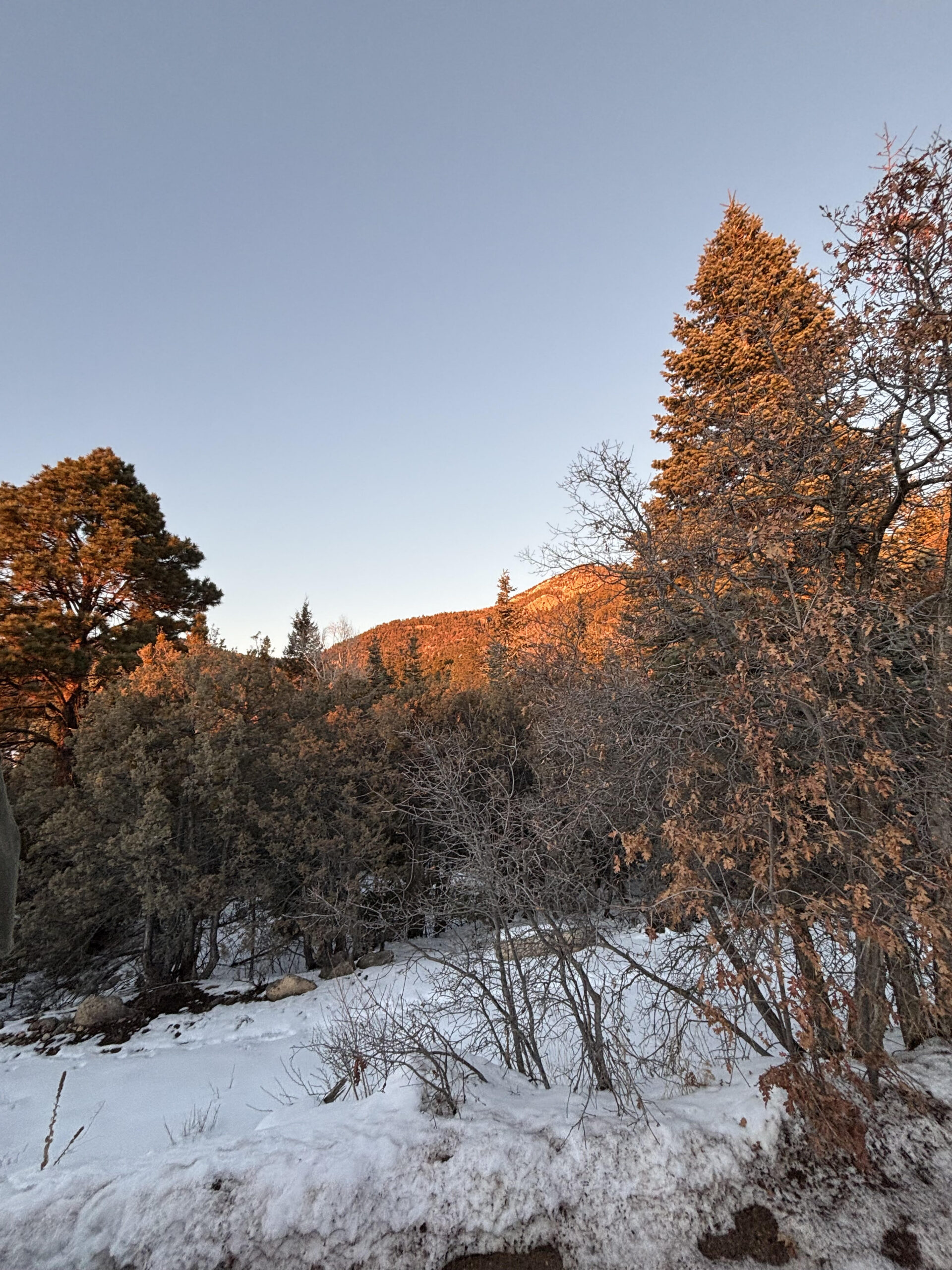
In my final weeks I drive back and forth on the highway trying to commit it to memory. I pass the faded billboard split between a warning that dog fighting is a crime and a more recent ad for Wendy’s 100% beef burgers. The mountains are lost in the blue today, dimpled snow lining the roadway. I study each mile, wondering how I will explain my time here, how I will translate what I love to people who haven’t seen it. I take note of the tin roofs, haggard trees gathered around farm houses as if to protect them. Light falls in stripes across the sage, dark fence posts in a rhythm against the road. Hay bales with the sides chewed away, worn away by cattle. I make sure to spend time with my old friends, the Sangres mountains. I try to recall the names of the peaks, their identities like distant relatives, familiar yet jumbled, hard to put names to faces.
I recently read an article The Coastal Elites Are Right, Actually by A.M. Hickman that puts a lot of my reflections and thoughts into words – it talks about the difference between the American hinterlands, and the places where the ‘coastal elite’ live. I think I fall into the category Hickman describes as ‘deracinated’. A rather visceral word describing a person who is “without roots, they have been severed (or have severed themselves) from their home-place, or they may descend from a long line of geographically unstable people who have chased opportunity around the country or even around the globe.”
Morose ponderings of rootlessness accompany all of my exits and entrances. In the words of author Ann Patchett, “some people are leavers, and some are stayers.” I seem to be a leaver.
In Alamosa, many people are stayers. They’ve been stayers since before Colorado was a state, before it was a part of the U.S., and before it was a part of any national entity.
People have been on their land for generations; they care deeply about this place. It’s an experience I have both questioned and admired. It is in fact, an experience that will never be open to me. You cannot create generations of history and land for yourself; you can only inherit it.
A.M. Hickman describes the people who live in the hinterlands, in places like Alamosa, as “blessed greatly with a world that works. They have their family, most likely; they have a place that is for them. They are blooming where they’re planted — because anything else seems strange, foreign, unnerving. Such people are blessed indeed, for they are removed from the weird and destabilizing ennui that real deracination breeds. They are content to live in our “interior swamps” and “sweaty dust bowls” without complaint, without yearning for some vestigial ruin of bygone luxury and sun-drenched decrepitude — they are strong people who need no great favors from the realms of power, climate, culture, or good wine. And indeed, the hinterlands are theirs, and their resilience is their immense and wonderful power.”
People often think about the San Luis Valley as a place that is under-resourced, impoverished, in need. There is truth to some of this. Most families are under the poverty line. The life of a farmer is difficult, impossible even, as climate change tightens its fist each year. Alamosa is far from the hubs of the coastal elite, far from the halls of power and decision-making.
But as I leave, I can’t help but think of Alamosa as a place of tremendous resource. An increasing number of people these days fall into my category of deracination.
We don’t know the year our ancestors immigrated to or were brought to this country. We often grow up miles or even countries apart from our extended family. We don’t know our stories.
There are lots of stories here. People don’t like to talk about themselves much, but they love to talk about their community, their place. Sit around a dinner table and you’ll hear the story of the Saguache sheep farmers coming together to rescue sheep stolen by bandits. Or the time people from all over the valley came together to dig out barns from the snow so the cows could be fed. Conversation often revolves around what buildings used to be, who owned them, who lived in them, what businesses used to be there and why they left. There are stories of surviving tough times, of legislation that almost got passed, of people who left and came back. People always come back, Valley residents say. It’s the frog spirits from when the valley used to be a giant prehistoric swamp, these spirits possess you and bring you back.
Alamosa is a little-known place in Colorado, similar perhaps to Galilee in Jesus’ day. Many people cannot imagine moving to such a place and deciding to live there. For those who cannot see this place as beautiful or valuable, A.M. Hickman suggests this: “To say that life in the hinterlands “sucks” is really only to make an admission that you yourself are in rough shape — that your family has cut their roots off, that you may be without faith, that you are in so low a state that you need the land and culture around you to do favors for you, to give you little pick-me-ups, to make life easy and pretty and sunny for you, even if it is mind-numbingly expensive to get there.”
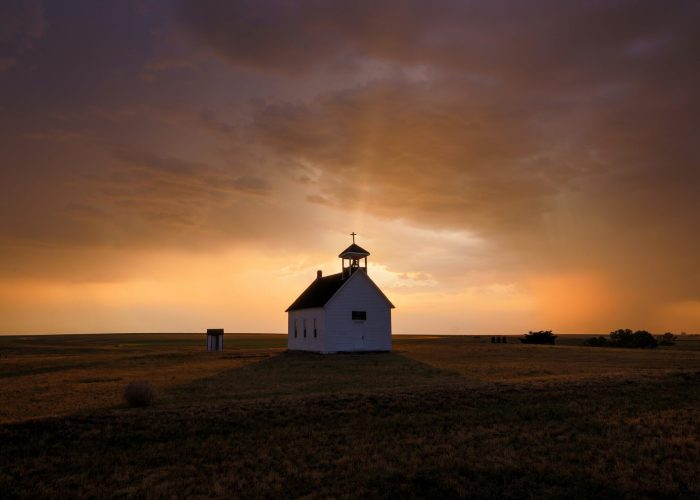
One of the sorrows of my deracinated life is a lack of a ‘hometown.’ I seem to be accruing places I love by the minute, but this only increases my bitterness at the ability of some to bring a spouse back to the place that formed them; to meet all of the people they love in one fell swoop. But there will be no hometown tour for me. Instead, I walk with God in the cool of the evening. I give a tour of my walk home. The orange low-lying wall that barely shields passersby from the catastrophe of scattered dog poop. The morgue where I read a book in a bad French accent. The abandoned white church building, its roofline always so crisp against the blue sky. The elderly black chihuahuas sitting behind their fence, no longer able to see passersby, but barking just in case.
Eventually, it comes time to do what I’m best at: leave.
I bid adieu to the box elder beetle crawling along the arch of my chair. We call them The Elders. They were here before me, and they’ll be here after me. I repack my suitcases in the airport, shuffling denim from one black case to the other.
And then I’m on the tarmac, the wind is picking up, and I know God is there. “I love this place,” I say.
“I love this place too,” God says.
There are a few moments of silence. “I loved this place before you got here.” God reminds me.
I ponder the many millennia God has spent loving this place. The rocks, the fields, the people.
“I will love this place after you leave.” God assures me.
I nod. “Me too.”
A few weeks later, I sit in Pittsburgh traffic, commiserating with a fellow deracinated friend. But as I lay in bed that night, I round the bend in my mind, and the mountains are there, sun at the top. Mt. Blanca drenched in a sunset haze. I feel transcendent.
Your support makes programs like MVS possible!