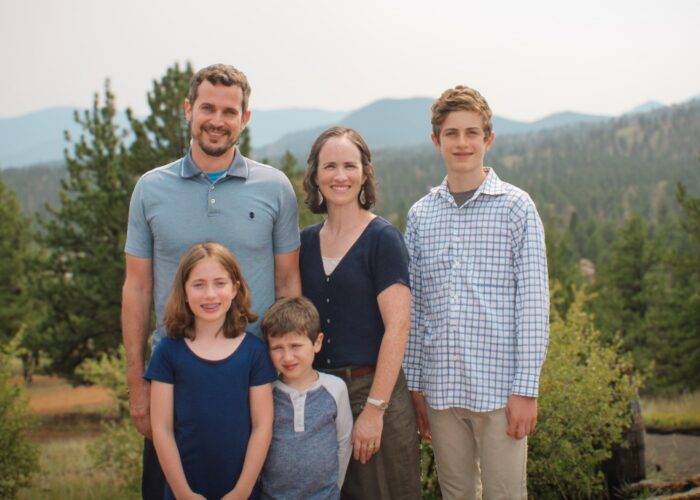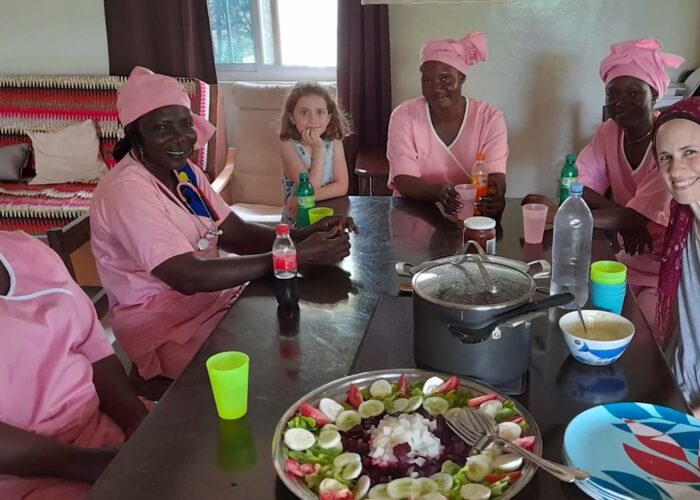

This reflection is from an Advent sermon Christy Harrison preached at the International Christian Fellowship of N’Djamena in Chad. Harrison and her family were jointly supported for ministry in Chad through Eastern Mennonite Mission and Mennonite Mission Network. The family’s visas were denied and they have recently relocated.
The International Christian Fellowship of N’Djamena in Chad, where our family worships, is engaged in a study of the things that we are commanded to do for one another as a community of believers. I would like to look at the faith of three people in the Christmas story in Luke 1. One person struggled to believe, one believed instantly and one both believed and encouraged belief in another. None of them could have walked their paths toward belief and obedience without their communities, that held them and built them up so they could respond to their calling.
Zechariah, the religious man, is silenced
It seems evident that a priest named Zechariah would have been the perfect candidate for a spokesperson for God, as he is from a good family and is respected in the community. He is even trusted with the duty of going into the sanctuary of the Lord, the great holy place. Zechariah is a righteous man, but also a disappointed man. For years, he and his wife, Elizabeth, have prayed for a child. In all his years of unanswered prayers, Zechariah has remained faithful to God, and to his childless wife. When Zechariah goes into the sanctuary, he is met by an angel who predicts the birth of his son, John, who will later be known as John the Baptist.
What a perfect way to proclaim the coming of the Christ: a much wanted and prayed for miracle is promised to a respectable man who has the voice and authority within the community to declare God’s word! But in an interesting turn of events, Zechariah, the person in the story most suited to speak for God, is the one made mute! All his training as a priest and years of experience in leadership did not guarantee that he would have the faith to believe in the power of God’s word, even when it was spoken to him directly by an angel. Like his wife’s ancestor Sarah, he doubts the angel’s words because he and his wife are too old to have children. And perhaps in his questioning “How?” we hear a little bit of Sarah’s laughter.
An unwed pregnant teenager more readily believes God’s message than “the perfect candidate.” Zechariah is part of a long line of religious leaders, who struggle to catch the vision of what God is doing, and in their unbelief, they lose their ability to speak God’s truth to their people. And so, God uses unexpected people to usher in this kingdom: the outcasts, women, tax collectors, prostitutes, pregnant teenagers, Gentiles and Samaritans.
Despite Zechariah’s unbelief, I am struck by the grace and tenderness God shows him. He continues to serve, albeit silently in his community. He is given the chance to watch the miracle he so doubted unfold before his eyes. He is granted a second opportunity, this time publicly, to affirm and proclaim God’s good work in his life. What a spiritual journey those nine months must have been for him!
Unanswered prayers may lead to disappointment
It is not always easy to trust in God’s goodness or miraculous action in our world, particularly when our prayers have gone unanswered for many years. To respond to disappointment upon disappointment with logic-defying belief is something anyone might struggle with. Sometimes we need a community that holds us patiently in our silence until we can proclaim again that the name is “John,” meaning “Our God is Gracious.”
In the 10 years that I have worked in African maternity wards, I have seen women and babies die from nearly every obstetric emergency there is. There have been times when I have struggled to testify to a God that is good and to a kingdom that is coming that will redeem all of creation. I remember one particularly difficult labor in Tanzania. It was the week before Easter. Things were not going well, and we were all scared. I asked if I could pray for her, reciting the well-known verses that God is gracious and merciful. In between contractions, she cried: “I have prayed to God and God has not answered me.”
I wish that I had voiced the perfect faith-filled words for her. I didn’t. I leaned over the blood and held her hand in silence. And when beautiful twin girls were born and never cried, never breathed, I wrapped them up and handed them to their mother. We cried together.
It was a season where I experienced many births like that one. I lost count of the deaths and in the process, I also lost my voice, lost my ability to testify to a God of healing and new life. Sometimes, when we are falling, before we can be built up, we need to be held. I am grateful for a community of faith that held me in my season of silence.
Silence can incubate faith
Zechariah needed this season of silence as well. It was only after nine months of muteness that he could truly testify. Zechariah’s faith was not only built up by the miraculous coming of his son, but by a God and a community that allowed him to watch silently as the miracle unfolded before him. A community, that then handed him a chalkboard, and offered him the chance, once again, to find his voice.
What difference would it make if we allowed each other seasons of grace-filled silence amid doubt?
Do we do this for each other?
Do we do this for our leaders?
Mary on the margins is given a strong voice
While Zechariah struggled to believe, Mary believes, immediately and unreservedly. Traditionally in the church, we have spent a lot of time focusing on Mary’s virtue and her obedience. Yes, she is a virgin, who in her questioning the “How?” of all this happening insinuates that she would be very uncomfortable with going out and sinning in order to make this whole plan come about. In this sense, she is very much unlike Sarah, who chose to take God’s promise into her own hands and have Abraham sleep with Hagar to produce a child.
And yes, Mary is also obedient, immediately obedient and without reserve. In her one sentence reply, “Let it be with me according to your word,” she agrees to the overhaul of every aspect of her life. But what I think, we often fail to recognize in Mary, is her incredible bravery. As a not quite married woman in a conservative society, she understands the kind of shame she will face when her pregnancy becomes evident. But even further, Mary lives at a time and place where access to good maternal healthcare is simply not there. Mary surely knows how dangerous it is to carry and give birth to a baby in her society. Chances are she knows some women personally who have died in childbirth. By saying yes, she is not only risking her reputation, and the potential loss of her fiancé, she is risking her very life.
Mary could give a resounding yes, in part because she belonged to a family and to a fiancé, who would give a resounding yes. Yes, to being misunderstood within their society and, yes, to losing family honor in a larger community that would not likely fall for this whole miraculous conception story. Mary is not the only one who counted the cost. Building Mary up and supporting her in her call came at a cost for her whole family.
Are we ready for God to speak to the young or young in their faith, the untrained, the inexperienced, the unexpected among us?
Are we ready to believe them? To support them? To build them up in their calling?
Elizabeth blesses and encourages
Elizabeth certainly was. She is pregnant with John when Mary visits her. Like Mary, Elizabeth knows what it is like for her reproductive life to be a source of shame within the community. While Mary’s pregnancy called into question her virtue, it is Elizabeth’s previous inability to get pregnant that has wounded her in her own community. Not giving birth in Biblical times, as well as now, can be a very heavy load for women to bear, particularly in societies where it is always assumed that it is the woman’s fault. I know of women who have been beaten by their husbands or abandoned and left to fend for themselves because they could not produce a child.
It is a testament to Elizabeth and Zechariah’s marriage that no surrogate mother has been proposed, following the lead of their ancestor, Sarah. Elizabeth and Zechariah clearly have years of experience in choosing faithfulness, a rather than caving under societal shame.
But while Elizabeth is going through a life-changing event of her own, when seeing Mary, she chooses not to focus on herself. But rather, in response to the Holy Spirit, she takes the time to bless and affirm Mary for what God is doing in her life. Before studying this text carefully, I had always thought that Mary sings The Magnificat right after receiving word from the angel Gabriel. But I am struck here, by the fact that even with a divine visitation, Mary needs the affirmation and encouragement of another human, in this case Elizabeth, for her to walk into her calling with joy and trust. It is Mary who sings The Magnificat, but it is Elizabeth who elicits this song from Mary.
And what a song it is!
Mary’s Magnificat declares a revolution for justice
We have seen that in her response to the word of Gabriel Mary shows obedience and fierce courage. But in her song, Mary proves to be downright revolutionary! She recognizes that this call on her life is not just about her. As a young, unwed mother, she is already capable of seeing beyond her own situation to acknowledge and care for the suffering of those around her. Driven by complete trust in what God is doing and strengthened by Elizabeth’s affirmation, she prophesies the new reign that this life growing in her will bring. A reign where the powerful will have their thrones taken away and the lowly will be lifted up, where the poor will be fed, and the rich will leave empty-handed.
This kind of revolutionary talk has made Mary’s song, The Magnificat, a very controversial passage throughout history. During the British occupation of India, The Magnificat was prohibited from being sung in churches. At the end of the British rule, Gandhi requested that this song be read in every place where a British flag was lowered. In the 1980s, the government of Guatemala and the military junta of Argentina banned any public display of the song. Dietrich Bonhoeffer, in an Advent sermon preached under Nazi rule said:
“The song of Mary is the oldest Advent hymn. It is at once the most passionate, the wildest, one might even say the most revolutionary Advent hymn ever sung. This is not the gentle, tender, dreamy Mary whom we sometimes see in paintings; this is the passionate, surrendered, proud, enthusiastic Mary who speaks out here… This song… is a hard, strong, inexorable song about collapsing thrones and humbled lords of this world, about the power of God and the powerlessness of humankind.”
Dietrich Bonhoeffer
While most of us do not come from places where this song is forbidden, we have become very adept at taming its meaning. We have turned Mary into a quiet angelic character who would have no problem with us overeating at our Christmas feasts while others go hungry. The truth is that if we are among the powerful and the well-fed, this song should make us uncomfortable.
As Christians we need the Marys of this world to unsettle us with their zealous obedience and their radical defiance of the status quo. We need The Magnificat to disrupt our way of thinking, and we need the courage to stand with Mary when she sings it.
Will we have the ears to hear it when it comes from such unexpected places?
Will we listen to those voices, believe them, and build them up?
In his book Global Humility, Andy McCullough reminds us of how God is always speaking through unexpected voices. He says: “Humble yourself to listen… Look to see whom the Holy Spirit is honouring, even if they don’t fit your box. Know that Christianity is always changing at the margins more profoundly than at the centre and position yourself accordingly. Know that churches or movements with no input from the margins will die.”
Zechariah’s Benedictus blesses future generations
Following The Magnificat, the first chapter of Luke ends with a second song. Traditionally called The Benedictus, Zechariah sings this song to his son, John. Zechariah uses his newfound voice to commission the next generation. Zechariah may have been slow to believe, but when he does believe, he holds nothing back, even his only child. He will raise his son to be a martyred prophet, giving his life to prepare the way for the coming Messiah. While The Magnificat was deeply revolutionary, The Benedictus is defiantly hopeful. Zechariah can now see God’s tender mercies coming from afar, ushering in a new dawn, guiding our feet into a new way of peace, calling us to serve without fear.
Elizabeth, Mary and Zechariah all play important parts in the gospel story, each with their own journey to faith and obedience. None of them got to that point of obedience alone. They needed their communities to build them up in different ways. Zechariah needed permission to be silent in his disillusionment and doubt. Mary needed Elizabeth to recognize the work of the Spirit in her. She needed her community to take risks with her and invite her to sing her song.
We need God’s community to wait in hope
In this time of Advent, we remember that while Jesus of Nazareth was in fact born 2,000 years ago, we still wait for the full coming of his kingdom.
As we look at all the pain in this world, and we might be tempted, like Zechariah to lose faith. We might be tempted to believe that all that we have been longing for and working towards might never come to be, and that suffering and evil win in the end. In those moments, may we slow to speak and quick to listen to the voice of Jesus spoken through our brothers and sisters on the margins, our brothers and sisters from places of struggle, those who are not usually given a voice but whose faith often surpasses ours.
As a community, may we also give space for the Zechariahs among us to sit with us in their doubt and disillusionment. No one is immune to discouragement, not even the priests, the long timers, the leaders. May we be a safe community in times of doubt as well as times of leadership.
Or perhaps it is our temptation to become so focused on what is happening in our own lives, in our own immediate circles, that we miss out on the Spirit’s prompting us to see Jesus in our sisters and brothers. May we follow Elizabeth’s example and be alert to those times when we should be eliciting the Spirit’s song in others.
And finally, in this season of waiting, may we follow Mary’s passionate example in declaring that the way things are is not the way things should be, that there is more to this story than what we can see. Like Mary, may we be willing to risk our reputations, our social standing, our lives for this declaration. And may we, like, Joseph, and like Mary’s family, be willing to stand with the Marys of this world, to believe them, to protect their calling, to build them up in their prophetic hour.
Because ultimately, we know that the king we wait for, chose to come as a child, completely dependent on humans like us. We all have a unique role to play but not one of us can do it alone. Advent reminds us that God’s kingdom is coming and that, like Zechariah, Elizabeth and Mary, God is using us to usher in this new way of life.