
Introduction
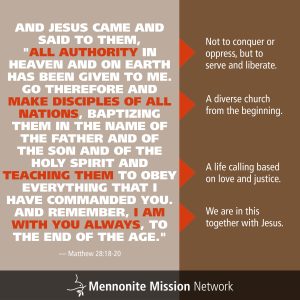
Make disciples of all nations. This imperative from Matthew 28:19 was the heartbeat of the 16th century Anabaptist movement. Along with Psalm 24:1 — “The earth is the Lord’s and all that is in it” (NRSV) — Matthew 28:19 and its parallel in Mark 16:15-16 were the most quoted texts in Anabaptist court testimonies. Ordinary believers used these texts to justify their calling to preach the gospel outside the channels of the state churches, baptizing only those who believed upon confession of faith — hence, repudiating infant baptism. As 2025 marks the 500th anniversary of Anabaptist origins, it is fitting that Anabaptist-Mennonite Christians revisit these last words of Jesus to his disciples — the Great Commission — as we seek to continue his mission today.
Focal text
Matthew 28:16-20
16 Now the eleven disciples went to Galilee, to the mountain where Jesus told them to go. 17 When they saw him, they worshipped him, but some doubted. 18 Jesus came near and spoke to them, “I’ve received all authority in heaven and on earth. 19 Therefore, go and make disciples of all nations, baptizing them in the name of the Father and of the Son and of the Holy Spirit, 20 teaching them to obey everything that I’ve commanded you. Look, I myself will be with you every day until the end of this present age.”
Supplemental texts
Genesis 12:1-3
1The Lord said to Abram, “Leave your land, your family, and your father’s household for the land that I will show you. 2 I will make of you a great nation and will bless you. I will make your name respected, and you will be a blessing.
3 I will bless those who bless you,
those who curse you I will curse;
all the families of the earth
will be blessed because of you.”
Exodus 33:12-16
12 Moses said to the Lord, “Look, you’ve been telling me, ‘Lead these people forward.’ But you haven’t told me whom you will send with me. Yet you’ve assured me, ‘I know you by name and think highly of you.’ 13 Now if you do think highly of me, show me your ways so that I may know you and so that you may really approve of me. Remember too that this nation is your people.”
14 The Lord replied, “I’ll go myself, and I’ll help you.”
15 Moses replied, “If you won’t go yourself, don’t make us leave here. 16 Because how will anyone know that we have your special approval, both I and your people, unless you go with us? Only that distinguishes us, me and your people, from every other people on the earth.”
Psalm 24:1-6
24 The earth is the Lord’s and everything in it,
the world and its inhabitants too.
2 Because God is the one who established it on the seas;
God set it firmly on the waters.
3 Who can ascend the Lord’s mountain?
Who can stand in his holy sanctuary?
4 Only the one with clean hands and a pure heart;
the one who hasn’t made false promises,
the one who hasn’t sworn dishonestly.
5 That kind of person receives blessings from the Lord
and righteousness from the God who saves.
6 And that’s how things are
with the generation that seeks him—
that seeks the face of Jacob’s God.
1 Peter 2:9-12
9 But you are a chosen race, a royal priesthood, a holy nation, a people who are God’s own possession. You have become this people so that you may speak of the wonderful acts of the one who called you out of darkness into his amazing light. 10 Once you weren’t a people, but now you are God’s people. Once you hadn’t received mercy, but now you have received mercy.
Life as strangers in the world
11 Dear friends, since you are immigrants and strangers in the world, I urge that you avoid worldly desires that wage war against your lives. 12 Live honorably among the unbelievers. Today, they defame you, as if you were doing evil. But in the day when God visits to judge they will glorify him, because they have observed your honorable deeds.
Contents
- Sermon starters: Guide your thinking about the Great Commission
- Worship resources: Plan a mission-themed worship service
- Stories from participants in God’s mission
- Join in God’s mission through Mennonite Mission Network
- Resources for further study

Sermon starters
Matthew 28:16-20 can be divided into two parts — a preamble that sets the scene (vv. 16-17) and Jesus’ speech to his disciples (vv. 18-20).
- The scene opens in Galilee, where Jesus had earlier directed “the eleven” to meet him (vv. 16, 28:10). What is the significance of Galilee in Matthew’s gospel? What other events in Jesus’ ministry happened there?
- Before Jesus met the eleven after his resurrection, he had appeared to Mary Magdalene and another Mary, whom he told to tell “[his] brothers” to “go to Galilee.” Where else in the Bible do you see women taking a leading role in announcing the good news of God’s reign? What might have happened if the eleven had not believed the women’s report enough to go to Galilee? What might this story suggest about the relationship between women and men in the mission of God?
- In Galilee, the disciples meet Jesus on “the mountain to which [he] had directed them.” In Matthew’s gospel, what other events in the ministry of Jesus occurred on “the mountain”? How might these other mountain events in the life of Jesus and his disciples affect the way we understand the mission which Jesus entrusted to his disciples from the mountain?
Jesus’ speech to his disciples includes four “all” statements.
- “All authority in heaven and on earth has been given to me” (v. 18).
- “Go therefore and make disciples of all nations” (v. 19).
- “… and teaching them to obey everything [“all things”] that I have commanded you” (v. 20a).
- “… I am will you always [“all the days”], to the end of the age” (20b).
In the middle of these, between statements two and three, is “baptizing them [“disciples of all nations”] in the name of the Father and of the Son and of the Holy Spirit …” (v. 19b)
Consequently, Jesus’ speech is framed by and focused on the presence of God with his people through Jesus. “All authority in heaven and on earth has been given to me. Go therefore …” (vv. 18-19a). “I am with you always” (v. 20b). New disciples are baptized “in the name of the Father and of the Son of the Holy Spirit,” into the presence of God.
- Why is it important that mission is infused with the presence of God? Why is it important that the presence of God precedes the command to “go and make disciples”? Why is it important that disciples are baptized into the name/presence of God?
- Jesus claims “all authority in heaven and on earth” and sends the disciples with that same authority. How does Jesus exercise authority in the gospel of Matthew? How is Jesus’ authority different from that of his opponents? What is the effect of Jesus’ authority on others? (See Matthew 7:28-29, 9:2-8, 10:1, 21:23-27) What are the implications of Jesus’ way of authority for how we do mission?
- Jesus sends his disciples to “make disciples of all nations.” Earlier in the gospel of Matthew, Jesus had sent his disciples only to “the lost sheep of the house of Israel” — not to “the nations” or Gentiles (10:5-6). How do you understand this expansion of focus for the disciples? Do you think that followers of Jesus should care about the needs of people outside their “own” families, communities, or nations? Why? How do you understand the relationship between engaging in ministry locally and globally?
- Besides the imperative, “make disciples,” Jesus’ speech includes three other verbs, all in participial form in the Greek: “going,” “baptizing,” and “teaching.” Disciples are made as disciples go, baptize, and teach others to practice everything that Jesus commanded them. In the gospel of Matthew, what did Jesus teach his disciples? What attitudes, virtues, and behaviors are characteristic of followers true to Jesus’ teaching?
- Earlier in Matthew, Jesus said that to love God with one’s entire being and to love one’s neighbor as oneself are as two parts of one commandment — the greatest commandment (22:34-40). Similarly, he said, “in everything do to others as you would have them do to you; for this is the law and the prophets” — “the Golden Rule.” When Jesus says that baptizing goes along with “teaching them to obey everything that I have commanded you,” do you think of the Great Commandment and the Golden Rule? When you think of mission, do you think of loving God and loving your neighbor as yourself? What does a mission motivated by love look like? And what might it look like to love God and others with a missional consciousness?
- What themes from the supplemental texts, listed above, do you see reflected in Matthew 28:16-20? What light do these texts shed on your understanding of the Great Commission?

Offering
Your gifts to Mennonite Mission Network make resources like this possible. Join us in sharing the word of God across the street and around the world by giving today. Click here to support our global work.

Worship resources
Songs from Voices Together
- No. 395 “The Church of Christ, in Every Age”
- No. 765 “Neno Lake Mungu (Listen, God is Calling)”
- No. 766 “Go in Grace and Make Disciples”
- No. 455 “Make Us One”
- No. 769 “Ey Lou Nis (Now I know)”
- No. 774 “Lord, You give the Great Commission”
- No. 834 “Thuma Mina (Send Me, Lord)”
- No. 43 “God, Be the Love”
- No. 284 “Lo, I am with You”
- No. 848 “Christ, Be All around Me”
- No. 180 “This is God’s Wondrous World”
Prayers and liturgies from Voices Together
- No. 993 “O God, Listening to us here…”
- No. 923 “Apostle’s Creed”
- No. 1009 “Source and Sustain of life…”

Stories
Stories



Video


Additional resources
- Bosch, David J. “The Structure of Mission: An Exposition of Matthew 28:16-20.” In Exploring Church Growth, edited by Wilbert R. Shenk, 218-48. Eugene, OR: Wipf and Stock, 2010.
- Friesen, Abraham. “The Great Commission as Anabaptist Manifesto.” In Anabaptist Visions for the New Millennium: A Search for Identity, edited by Dale Schrag and James Juhnke, 175-80. Kitchener, ON: Pandora, 2000.
- Krabill, James R. “Characteristics of Anabaptist Mission in the Sixteenth Century.” In Sixteenth-Century Mission: Explorations in Protestant and Roman Catholic Theology and Practice, edited by Robert L. Gallagher and Edward L. Smither, 163-79. Bellingham, WA: Lexham, 2021.
- Littell, Franklin H. “The Anabaptist Theology of Mission.” In Anabaptism and Mission, edited by Wilbert R. Shenk, 13-23. Scottdale, PA: Herald Press, 1984.
- Ott, Bernhard. “Matthew 28:16-20 and the Holistic Mission Debate: An Anabaptist Contribution.” Mission Focus: Annual Review 14 (2006): 149-165.
- Sawatzky, Joseph C. L. With Steadfast Devotion: A Vision of the Church in Mission in ‘4 Ms’. Missio Dei, no. 33. Elkhart, IN: Mennonite Mission Network, 2024.
- Shenk, Wilbert R. “Why Missional and Mennonite Should Make Perfect Sense” In Fully Engaged: Missional Church in an Anabaptist Voice, edited by Stanley W. Green and James R. Krabill, 19-28. Harrisonburg, VA: Herald Press, 2015.
- Suderman, Andrew G. “Who’ll Be a Witness for My Lord?: Exploring the Power to Be a Witness.” Anabaptist Witness 4, no. 1 (April 2017): 47-59. https://www.anabaptistwitness.org/journal_entry/wholl-be-a-witness-for-my-lord/
- Tizon, Al. Whole and Reconciled: Gospel, Church, and Mission in a Fractured World. Grand Rapids: Baker Academic, 2018. See especially 166-170.

Join in God’s mission

Visit our website for more stories from Mission Network workers and alumni who are, or have served in many places across the globe.

Become a prayer partner. Join a worldwide network of people who support Mission Network through prayer.

Serve with us! Individuals and families may choose from many programs to serve domestically or internationally.

Your gifts to Mennonite Mission Network make resources like this possible. Join us in sharing the word of God across the street and around the world by giving today. Click here to support our global work.