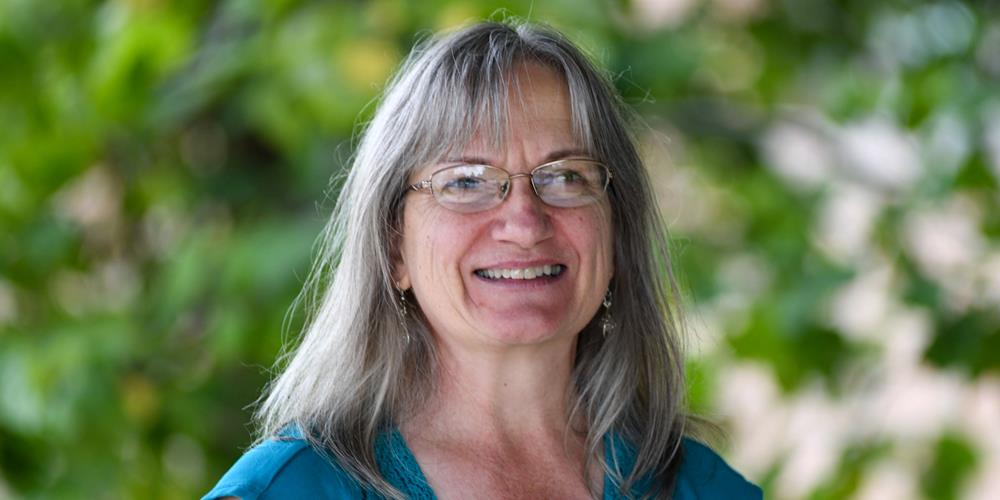

For 32 years, Mennonite Mission Network worker Laura Schlabach served in Mongolia with JCS International. Her term concluded in late March. She served in numerous roles in the Mission Network partner organization, including accounting, human resources, and interim executive director; witnessing a country emerge from decades of communist governance with around 1,000 self-identifying Christians in 1993, to approximately 60,000 in 2025.
NEWTON, Kansas (Mennonite Mission Network) – In the dark beyond the concert lights, deep in the audience, Laura Schlabach watched the video screen above the stage. The concert was nearly at its end. Keith Green, the musician whose songs Schlabach and the crowd had sung along to throughout the evening, appeared onscreen. Just a few months before, the pioneering Contemporary Christian artist had died in an airplane accident. His scheduled slate of concerts continued, however, as a tribute to Green and his ministry of music. Now, through a previously recorded interview, he addressed the crowd.
Green cited Matthew 28:19 – the Great Commission. “Go therefore and make disciples of all nations, baptizing them in the name of the Father and of the Son and of the Holy Spirit” (NRSVU).”
“If you are not called specifically to stay at home or stay where you are,” Schlabach recalled him saying, “this verse is calling you to go.”
That was the moment that Schlabach first felt the call to international ministry. It was 1982, and she was a college sophomore working towards a business major in accounting – an education that at first glance, didn’t seem to mesh with her newfound call to service. The next year, she paused her studies and joined the fledgling Voluntary Service (VS) unit in San Antonio, Texas, through Mennonite Board of Missions (MBM), a predecessor agency of Mission Network. The VS program is now Mennonite Voluntary Service.
“I can’t say I was consciously thinking about exploring [my call to service], but looking back, that’s what I was doing,” Schlabach said.
Texas service to Mongolia ministry
At the end of her two-year term with VS, Schlabach knew two things: she still felt called to live a life of service and, however paradoxically, also finish her business accounting degree. She graduated from University of Texas and began working in the nonprofit sector, helping transition analog accounting operations to digital. Her calling still weighed on her heart.
Meanwhile, the country of Mongolia was shifting dramatically.
Neighboring the Soviet Union and China, Mongolia was closely aligned with the USSR for much of the 20th century. After declaring independence from China in 1921, the country established a single-party communist government in 1924. Similarly to the Soviet Union, this new regime violently suppressed the public practice of religion, including Buddhism, which had been intertwined in the previous governments for centuries. In 1990, as the USSR crumbled, Mongolians staged a peaceful democratic revolution of their government, breaking away from Soviet influence, and opening the country to connect with the rest of the world. The open practice of religion, crushed for decades, was now possible. Christian mission organizations, including MBM, began to explore ways to have a presence in this country that had just five known Christians in 1990.
Three years later, that presence became manifest through JCS International. Originally intended to be named Joint Christian Services International, a government official recommended leaving out the explicit reference to Christianity, in case the newly religion-friendly government changed its stance towards religious organizations. In 1993, JCS International was registered as a development and relief organization in Mongolia, with the goal of engaging in wholistic projects across the country to meet community needs. MBM was one of the nine supporting agencies of the joint venture.
As the organization began to come together, the complexities that came with managing finances for development projects became clear. JCS International needed someone in-country with a very specific set of training and skills: accounting.
Schlabach recalled hearing about MBM’s search for an accountant from a friend. When she called to get more information on the position, each detail felt like another confirmation of God’s call for her to serve, though she admits she wasn’t sure where Mongolia was located at time. “I was too embarrassed to ask,” she said.
The final sign of God’s providence came soon after. Schlabach learned that seven churches in northeast Ohio, including the one she had grown up in, had been exploring a new partnership model with MBM. Typically, a congregation would give money to MBM, with the expectation that the agency would support several ministries and workers around the world. Instead, the churches wanted to focus on a specific country, and grow in relationship with the people their finances supported. Mongolia, with its newly opened borders, and JCS International needing support, seemed like the perfect fit. The Mongolia Mission Partnership (MMP) was born, with Schlabach as its first sponsored worker arriving in-country December 1993.
MMP was “another confirmation that God’s preparing the way, and God’s directing,” Schlabach says. “The partnership has been wonderful over the years.”
Faith through shifting roles
San Antonio Mennonite Church, which hosted Schlabach during her VS term and where she later became a member, also committed to support her financially. While MMP began with congregations, businesses and individuals joined over the years as well.
Together, MMP hosted worship services, banquets and fundraising events to learn from and support JCS International, Schlabach, and other workers in Mongolia. Individuals and teams from MMP travelled to Mongolia to visit the locations and people they had learned so much about.
Schlabach served in accounting at JCS International for several years, before transitioning into Human Resources to work with volunteers and workers. It was a change she felt unprepared to make, both personally and professionally. A comment from an external auditor helped change her mind. “You might as well do what you’re already doing,” he said.
Volunteers and workers with JCS would frequently talk with her about finances. Then they would stay and discuss the things that were going well, the things that weren’t, and the things they needed an outside perspective to navigate. Schlabach hadn’t known it, but she had been informally training for this job change for years. She later spent two years in a remote area, involved in a project to equip families to grow gardens and raise new herds of livestock after catastrophic winter storms. She served ten years in the countryside, walking alongside a local church and assisting with development projects. Eventually, she returned to JCS’ headquarters in the capital city of Ulaanbaatar taking on roles in finance, information technology and even serving as interim executive director.
“I came full circle and then some,” she said.
A witness to a nation’s spiritual growth
As her roles in JCS International shifted and changed, Schlabach was witness to Mongolia changing, too. When she arrived, Mongolia had about 1,000 self-identifying Christians. In 2025, that number had blossomed to an estimated 60,000 (2% of the population). Schlabach attributes much of this growth to the spiritual void left by decades of religious suppression.
“There was a void for people, and so they were seeking to fill it,” she said. Throughout her work, Schlabach witnessed the enthusiasm for the Gospel firsthand.
She recalled one community gathering about Christian missions where a man abruptly stood up mid-discussion and made his way for the door. When asked where he was going, he replied, “We need to share this with others! So, I’m going out to share.”
“Mongolians are natural evangelists,” she said. “They’re just on fire to go spread it.”
While JCS International is not in the business of starting or leading churches, Schlabach noted that the organization has served as an inspiration for the country’s Christian communities. JCS International has multiple member organizations, each from a different denominational background. Yet, they united through JCS International to focus on community development projects together. “That’s been a real witness for [Mongolian Christians] with the church working together.”
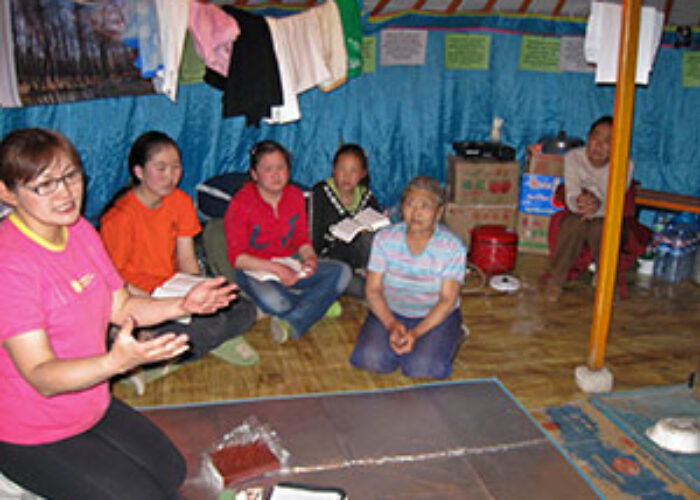
At a final gathering at the Mission Network offices in Elkhart, Indiana, Schlabach reflected on some of the changes she had seen in Mongolia over her ministry. Many families have shifted from a traditional nomadic lifestyle of raising livestock to urban apartments and city jobs. Gers – movable tent-like houses made from cloth and wood, are being replaced by ridged wood and metal houses transported by truck instead of camel. Supermarkets have replaced the small, sporadically stocked shops in the cities. All of these changes bring new opportunities and challenges for Mongolian Christians, and JCS International, as well.
“Thankfully, God has not changed,” Schlabach said. “And whatever is happening, God is at work. To God be the glory.”
Your financial support helps make our work possible.