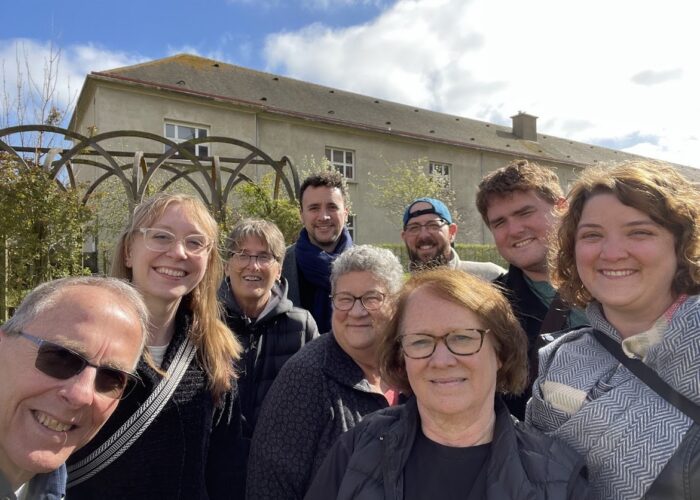

Shelby Rudy journeyed to France for chapter two of the Christ at the Borders Just Peace Pilgrimage in Calais. She was joined by eight other adults, including Mission Network staff, as well as Joseph and Rachel Givens, who serve with Mission Network at the Maria Skobtsova House. This blog was originally posted to Shelby’s website on May 12.
Check out part one of her blog.
Cape Griz-Nez
The next morning we spent some time walking and reflecting around Cape Griz-Nez, which looks out over the Channel. Joseph had given us some prompts for reflection, and I encouraged my mind to wander.
- I don’t know why, but I thought the Channel was like the Columbia River between Oregon and Washington. It’s not, it’s five times the size. On a clear day, you can see the cliffs of Dover in England, but generally, the sky and the water meet on the horizon. To think about crossing that in a blow-up boat that is over capacity in the dark of night with or without a life jacket is terrifying. The courage and tenacity mixed with desperation of migrating peoples’ circumstances to try as many times as it takes is astounding.
- There were sheep up on the hill and I was reminded of all the imagery in John 10 about Jesus being our Shepherd and we the sheep:
“I am the good shepherd. The good shepherd lays down his life for the sheep. . . I am the good shepherd; I know my sheep and my sheep know me— just as the Father knows me and I know the Father—and I lay down my life for the sheep.” (John 10:14-15, NIV)
I believe these things to be true of God — that God will provide, grant refuge and safety, and care for people. Meanwhile, I wrestle with the idea that in reality, not everyone is safe. And tears came to my eyes (and still do) as I thought of the hundreds of people who have died needlessly crossing the Channel. Still yet, there are stories of salvation and providence as people risk their lives to cross.
Secours Catholique
That afternoon we volunteered with Secours Catholique (Catholic Aid), which is a day center open two days a week to migrating people. It offers laundry, charging stations, a shuttle for showers, food, and other resources. It is split into two areas — one for women and children exclusively, and one open to everyone.
I wandered back and forth a bit between the women’s side and the area open to everyone. This was where sandwiches were being handed out, laundry was being done, men were taking sponge baths and giving each other haircuts, as well as internet-related tasks. It wasn’t just business, though. Music was playing, people were playing football, a lady was drawing portraits inside, and men were selling cigarettes outside. It was a very alive place and it struck me that regardless of people’s circumstances, laughter and joy still lived on.
Our time at Secours Catholique allowed us to see firsthand how desperate the situation is and again put faces to “the migrant crisis.” Normally, it’s easy to distance yourself from the hurt or horrible circumstances, but when you see the exhaustion in people’s eyes, and their pain and sorrow, it’s impossible to ignore. And while it is a grim reality, the beauty of human perseverance and the joy that is still expressed were notable to me.
This stop also gave me an opportunity to see the local French community come together to help the “others” in their neighborhood. The woman heading up the women’s side was a local retiree who volunteers once a week. Other migrants were volunteering. There were French people and volunteers from other organizations there. It was special to see all these people coming together to help migrants get resources.
Calais to Dover to London
The next day, we crossed the Channel on a ferry and as we did so, we were encouraged to reflect upon the migrants who make this crossing under cover of nightfall and in overcrowded boats. Once again, we saw the border walls blocking the road leading to the loading zone. We crossed through French immigration, where we drove through a heat sensing chamber to make sure our vehicle didn’t have any undocumented people on it. We then crossed through the United Kingdom (UK) immigration, where they asked us questions about our travels. Notice again how UK immigration has a presence on the French side, and yet migrants have no ability to claim asylum on the French side.
The weather was beautiful, so I stayed out on the deck most of the time. The crossing itself took about 90 minutes, in contrast with the anywhere from two to ten hours it can take migrants to cross at night. Never once did I fear for my life and I barely felt the sea spray on my face. Overall, it was a very comfortable trip, all because I had a little money and a piece of paper that told the government it was okay for me to come. One of the other pilgrimage participants mentioned that most of the people on the ship looked like us — White, whereas all the migrants we saw were People of Color.
Panel of migrants
After church at Amott Road Baptist Church, they held a panel with Cerena (whom we had met the night before), a couple named Oreana and Chiro, as well as their newborn baby (these are not their real names for their privacy). All of them, as well as Cerena’s family, had stayed with Joseph and Rachel at the Maria Skobtsova House (MSH) and were now making a way for themselves in the UK. Cerena shared that she and her husband had come to know Jesus in their home country and were attending a house church because it is illegal to be Christian there. Somehow, the government found out about their house church and started pursuing the attendees, so her family made the difficult decision to leave everything they knew to escape religious persecution.
During their first attempted crossing from Calais, their boat exploded and she and her family, who could not swim, were stranded in the freezing water without life jackets. She told us how she looked up at the stars and prayed for salvation, and after 40 long minutes, the French Coast Guard found them and rescued them. Two of her children had fluid in their lungs and were rushed to the hospital. Not knowing what else to do and struggling with the language barrier, she called Joseph, who came bearing Burger King (a family favorite) and helped her get reunited with her family. Later, she and her family made the dangerous crossing successfully. You can read Joseph’s first-hand account of this story here.
Chiro shared about how he was facing ethnic persecution by his home country. His ethnicity is not recognized by his home country and he was arrested at a demonstration advocating for freedom. He was tortured and forced to give up names to avoid worse persecution. Miraculously, he was able to escape and met Oreana as they were migrating through Germany. Together, they crossed to the UK where she got the medical help she needed and now they have a baby. One of the other pilgrimage participants, Matthew, was able to talk a bit more with Chiro and had more details on his story. I encourage you to listen to his account to his church here.
Seeing these individuals, you likely would never guess the horrible things they have seen and experienced. They were smiling, laughing, at ease, and hopeful. While migrating to the UK has not solved all their problems, it did give them a chance for a better life and hope for their kids.
The group
Joseph and Rachel, whose full-time ministry is to serve the migrant community in Calais, did such a wonderful job of educating, leading, and hosting us. They were so patient with all our ceaseless and repetitive questions, encouraged us to reflect on the tough questions that arose, wrestled with us in our struggles, and gave us space to engage with those complex feelings. Know that with everything I wrote about, they were the ones to show us and educate us. If you would like to follow their journey or support them financially, I would encourage you to do so here.
I’m grateful to Mennonite Mission Network for coordinating and administering this trip. They’ve made it a priority to learn about social justice issues, as is seen in their trips to borders with a migrant crisis and taking US racial justice pilgrimages. It’s encouraging to me to see the church involved in educating people in this way, as well as the ministries they get to visit while there. If you’d like to learn more about what they do, I encourage you to do so here.
Just Peace Pilgrimages are designed for participants to listen, learn and explore what God is doing to bring about justice and peace in the world. To learn more about Just Peace Pilgrimages, including how you can sign up, visit MennoniteMission.net/JustPeace.