
Introduction
Deciding how to participate, or to participate at all, in the political process can be a spiritual exercise when pursued through prayer and in discerning communities of faith. The result of that exercise will lead followers of Jesus to different conclusions. These differences need not lead to division in the body of Christ. With our ultimate allegiance to Jesus, the church at every level can continue engaging in God’s mission of peace and reconciliation, even as we differ in how, or if, we vote.
This year, the Peace and Justice Support Network invites your community to consider “agreeing and disagreeing in love” together as a Jesus-centered response to a political process that too often seeks victory by creating and exploiting division. The church’s faithful witness to Jesus will not be announced by voting for a particular candidate. Instead, it will be announced as we model together how to love one another even in the midst of difference.
These materials are from two Mennonite Church USA congregations: Kern Road Mennonite Church and Ridgeview Mennonite Church. These communities have shared their own approaches to agreeing and disagreeing in love. Please use them as presented, or feel free to adapt them to your community. Thanks to Pastor Mick Sommers of Ridgeview Mennonite Church and Pastor Janice Sutter of Kern Road Mennonite Church for their efforts in making these materials available.
In this season of election year politics and many divisive issues in faith and culture, we still strive toward unity and maturity as a faith community. Seeking to learn, love, and live God’s dream for the world, we’ll return to a document that has guided us in years past, the Mennonite Church USA statement, “Agreeing and Disagreeing in Love.” We’ll listen to the guidance of Scriptures, including Ephesians 4:1-6, Matthew 7:1-5, and Romans 14:10-13.
Scripture texts
Focal texts
Ephesians 4:1-6 (CEB)
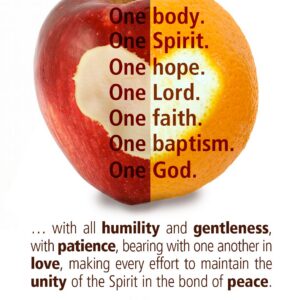
1 Therefore, as a prisoner for the Lord, I encourage you to live as people worthy of the call you received from God. 2 Conduct yourselves with all humility, gentleness, and patience. Accept each other with love, 3 and make an effort to preserve the unity of the Spirit with the peace that ties you together. 4 You are one body and one spirit, just as God also called you in one hope. 5 There is one Lord, one faith, one baptism, 6 and one God and Father of all, who is over all, through all, and in all.
Matthew 7:1-5 (CEB)
1 “Don’t judge, so that you won’t be judged. 2 You’ll receive the same judgment you give. Whatever you deal out will be dealt out to you. 3 Why do you see the splinter that’s in your brother’s or sister’s eye, but don’t notice the log in your own eye? 4 How can you say to your brother or sister, ‘Let me take the splinter out of your eye,’ when there’s a log in your eye? 5 You deceive yourself! First take the log out of your eye, and then you’ll see clearly to take the splinter out of your brother’s or sister’s eye.
Romans 14:10-13 (CEB)
10 But why do you judge your brother or sister? Or why do you look down on your brother or sister? We all will stand in front of the judgment seat of God. 11 Because it is written,
As I live, says the Lord, every knee will bow to me,
and every tongue will give praise to God.
12 So then, each of us will give an account of ourselves to God.
13 So stop judging each other. Instead, this is what you should decide: never put a stumbling block or obstacle in the way of your brother or sister.
Suplemental texts
Matthew 5:21-24 (CEB)
21 “You have heard that it was said to those who lived long ago, Don’t commit murder, and all who commit murder will be in danger of judgment. 22 But I say to you that everyone who is angry with their brother or sister will be in danger of judgment. If they say to their brother or sister, ‘You idiot,’ they will be in danger of being condemned by the governing council. And if they say, ‘You fool,’ they will be in danger of fiery hell. 23 Therefore, if you bring your gift to the altar and there remember that your brother or sister has something against you, 24 leave your gift at the altar and go. First make things right with your brother or sister and then come back and offer your gift.
Mark 2:13-17 (CEB)
Eating with sinners
13 Jesus went out beside the lake again. The whole crowd came to him, and he began to teach them. 14 As he continued along, he saw Levi, Alphaeus’ son, sitting at a kiosk for collecting taxes. Jesus said to him, “Follow me.” Levi got up and followed him.
15 Jesus sat down to eat at Levi’s house. Many tax collectors and sinners were eating with Jesus and his disciples. Indeed, many of them had become his followers.16 When some of the legal experts from among the Pharisees saw that he was eating with sinners and tax collectors, they asked his disciples, “Why is he eating with sinners and tax collectors?”
17 When Jesus heard it, he said to them, “Healthy people don’t need a doctor, but sick people do. I didn’t come to call righteous people, but sinners.”
Luke 7:36-50 (CEB)
Forgiveness and gratitude
36 One of the Pharisees invited Jesus to eat with him. After he entered the Pharisee’s home, he took his place at the table. 37 Meanwhile, a woman from the city, a sinner, discovered that Jesus was dining in the Pharisee’s house. She brought perfumed oil in a vase made of alabaster. 38 Standing behind him at his feet and crying, she began to wet his feet with her tears. She wiped them with her hair, kissed them, and poured the oil on them. 39 When the Pharisee who had invited Jesus saw what was happening, he said to himself, If this man were a prophet, he would know what kind of woman is touching him. He would know that she is a sinner.
40 Jesus replied, “Simon, I have something to say to you.”
“Teacher, speak,” he said.
41 “A certain lender had two debtors. One owed enough money to pay five hundred people for a day’s work.[a] The other owed enough money for fifty. 42 When they couldn’t pay, the lender forgave the debts of them both. Which of them will love him more?”
43 Simon replied, “I suppose the one who had the largest debt canceled.”
Jesus said, “You have judged correctly.”
44 Jesus turned to the woman and said to Simon, “Do you see this woman? When I entered your home, you didn’t give me water for my feet, but she wet my feet with tears and wiped them with her hair. 45 You didn’t greet me with a kiss, but she hasn’t stopped kissing my feet since I came in. 46 You didn’t anoint my head with oil, but she has poured perfumed oil on my feet. 47 This is why I tell you that her many sins have been forgiven; so she has shown great love. The one who is forgiven little loves little.”
48 Then Jesus said to her, “Your sins are forgiven.”
49 The other table guests began to say among themselves, “Who is this person that even forgives sins?”
50 Jesus said to the woman, “Your faith has saved you. Go in peace.”
1 Corinthians 11:27-29 (CEB)
27 This is why those who eat the bread or drink the cup of the Lord inappropriately will be guilty of the Lord’s body and blood. 28 Each individual should test himself or herself, and eat from the bread and drink from the cup in that way. 29 Those who eat and drink without correctly understanding the body are eating and drinking their own judgment.

Sermon starters
Idea 1
Scripture: Matthew 7:1-5, Ephesians 4:1-6, portions of Romans 14
Start with a story about a conflict being resolved in a family.
Years ago, as a hospital chaplain, I remember seeing a dramatic resolution of conflict in a family who had gathered to surround their mother as she lay dying. A conflict had festered between two family members for years, but after years of not seeing each other, they met in a warm embrace with apologies.
I was touched by this scene, and was also aware of how human it was. If you grew up in a family, you know that conflict is a normal part of life.
Tell a story about conflict in the church in the past. (Maybe a humorous one!) Refer to evidence of conflict in church life as we read The Mennonite or the Mennonite World Review. If you are part of a church, you know that conflict is a normal part of life in the church. (These stories highlight the first point of Agreeing and Disagreeing in Love, which is “Accept conflict. Acknowledge together that conflict is a normal part of our life in the church.”)
We know that conflict was also a normal part of life in the early church. Especially in the New Testament letters, we find all kinds of advice and wisdom about how to work with conflict in a healthy and Christ-like way. Eugene Peterson has an engaging paraphrase of the conflict about church conflicts in Romans 14. We still have differences in our congregations about what to eat and what not to eat!
Talk about the divisiveness of the current political debate. Hopefully, we have variety in the political parties represented in our congregation. As Christians, it is not our practice to put our ultimate hope in any political party, but in Jesus Christ. How can we talk together across party lines? As our nation continues to become so divided along political issues, we as a church need to live and show something different.
Introduce/review the Agreeing and Disagreeing in Love statement. Invite people to “sign on” to this way of living with difference in their lives.
Idea 2
Scripture: Matthew 5:21-24, 1 Corinthians 11:27-29, Luke 7:36-50
Review the idea that conflict is a normal part of life with others, in our families and in our congregation. Our challenge is to live with our differences in healthy and Christ-like ways.
This is not a new challenge. There is conflict all over the Bible we read … because there are human stories all over the Bible we read. Read a variety of excerpts from the New Testament letters written to people in conflict with one another. Check out Peterson’s The Message paraphrase.
Name a variety of issues in which there is great diversity of viewpoints in your congregation. Here’s a list to get you started: use of wealth, lifestyle decisions, alcohol consumption, material possessions, food choices, divorce, homosexuality, racism, patriotism, biblical interpretation, women in ministry, use of technology, political persuasion ….
As our neighborhoods, our nation, and world communities continue to become so divided on these and other issues, we as a church have a great opportunity to model something different. Jesus calls us to maturity in working with our conflict. This is not the way of our culture, or even of human nature. As in many areas of our life, Jesus calls us beyond our first impulses, to make choices that are healthy for us and our communities.
Matthew 5:21-24. How we resolve our conflict is so important that God wants us to work at reconciliation even before we bring our offerings of time, talent and money to the altar.
1 Corinthians 11:27-29. Here is the invitation to examine oneself before partaking in communion. In our history, we have taken this invitation very seriously as a call to be reconciled with God and our brothers and sisters before we gather at the Lord’s Table.
Luke 7:36-50. This story of the sinful woman washing Jesus’ feet at Simon’s house highlights how Jesus invites Simon to see the woman as he sees her, beyond simple labels and past history. Jesus invites us to be a community that sees and receives others.
Idea 3
Scripture: Mark 2:13-17, Ephesians 4:1-6
Tell stories of church leaders in the past who worked creatively with conflict. Conflict is part of our history, and working creatively with conflict is part of our history as well. The story of Jesus in Mark’s Gospel is a scene of the Pharisees confronting Jesus about eating with sinners. Even as they confront him, Jesus is still talking with the Pharisees. He maintains relationship with them.

Offering
Your gifts to Mennonite Mission Network make resources like this possible. Join us in sharing the word of God across the street and around the world by giving today. Click here to support our global work.

Worship resources
Songs from Voices Together
Gathering song
- No. 25 “Brethren, we have met to worship,”
Congregational singing
- No. 424 “We worship God the rock,”
- No. 797 “We are people of God’s peace,”
Song of response
During the song of response, invite people to come to a display of the Mennonite Church USA Agreeing and Disagreeing in Love statement and pick up a copy to take home and study. If they are ready, they can sign on as a way to commit to using these principles and practices in their own life.
Sending song
- No. 239 “He came down,”
Other song suggestions
- No. 722 “Help us to help each other,”
- No. 30 “Jesus calls us here to meet him,”
- No. 420 “God of the Bible,”
- No. 719 “Jesus, help us live in peace,”

Join in God’s mission

Visit our website for more stories from Mission Network workers and alumni who are, or have served in many places across the globe.

Become a prayer partner. Join a worldwide network of people who support Mission Network through prayer.

Serve with us! Individuals and families may choose from many programs to serve domestically or internationally.

Your gifts to Mennonite Mission Network make resources like this possible. Join us in sharing the word of God across the street and around the world by giving today. Click here to support our global work.

Graphics