
Scripture texts
Focal text
Luke 19:41-44 (CEB)
41 As Jesus came to the city and observed it, he wept over it. 42 He said, “If only you knew on this of all days the things that lead to peace. But now they are hidden from your eyes. 43 The time will come when your enemies will build fortifications around you, encircle you, and attack you from all sides. 44 They will crush you completely, you and the people within you. They won’t leave one stone on top of another within you, because you didn’t recognize the time of your gracious visit from God.”
Supplemental texts
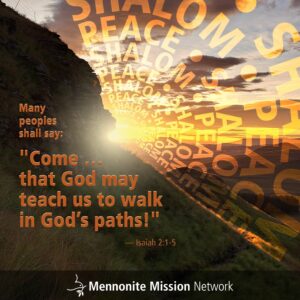
Isaiah 2:1-5 (CEB)
1 This is what Isaiah, Amoz’s son, saw concerning Judah and Jerusalem.
2 In the days to come
the mountain of the Lord’s house
will be the highest of the mountains.
It will be lifted above the hills;
peoples will stream to it.
3 Many nations will go and say,
“Come, let’s go up to the Lord’s mountain,
to the house of Jacob’s God
so that he may teach us his ways
and we may walk in God’s paths.”
Instruction will come from Zion;
the Lord’s word from Jerusalem.
4 God will judge between the nations,
and settle disputes of mighty nations.
Then they will beat their swords into iron plows
and their spears into pruning tools.
Nation will not take up sword against nation;
they will no longer learn how to make war.
5 Come, house of Jacob,
let’s walk by the Lord’s light.
Psalm 2 (CEB)
1 Why do the nations rant?
Why do the peoples rave uselessly?
2 The earth’s rulers take their stand;
the leaders scheme together
against the Lord and
against his anointed one.
3 “Come!” they say.
“We will tear off their ropes
and throw off their chains!”
4 The one who rules in heaven laughs;
my Lord makes fun of them.
5 But then God speaks to them angrily;
then he terrifies them with his fury:
6 “I hereby appoint my king on Zion,
my holy mountain!”
7 I will announce the Lord’s decision:
He said to me, “You are my son,
today I have become your father.
8 Just ask me,
and I will make the nations your possession;
the far corners of the earth will be your property.
9 You will smash them with an iron rod;
you will shatter them like a pottery jar.”
10 So kings, wise up!
Be warned, you rulers of the earth!
11 Serve the Lord reverently—
trembling, 12 kiss his feet[a]
or else he will become angry,
and your way will be destroyed
because his anger ignites in an instant.
But all who take refuge in the Lord are truly happy!
Ephesians 2:14-17 (CEB)
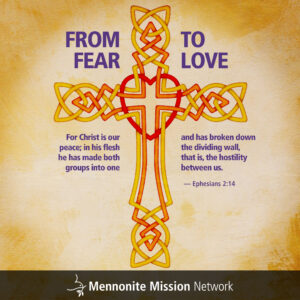
14 Christ is our peace. He made both Jews and Gentiles into one group. With his body, he broke down the barrier of hatred that divided us. 15 He canceled the detailed rules of the Law so that he could create one new person out of the two groups, making peace. 16 He reconciled them both as one body to God by the cross, which ended the hostility to God.
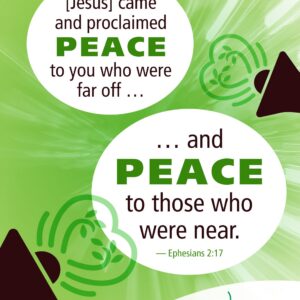
17 When he came, he announced the good news of peace to you who were far away from God and to those who were near.
Sermon starters
The mission of God — the mission that Mennonite Mission Network engages with on a daily basis — is what Jesus died for: that God’s creation would be at peace, with its maker and its neighbor. This was Jesus’ ministry and the vision of the prophets. That’s why, on his way to the Passover feast, when Jesus drew near and saw the city, Jerusalem, he wept over it: “If you, even you, had only recognized on this day the things that make for peace! But now they are hidden from your eyes” (Luke 19:42, NRSVUE).
“Even you” is a poignant phrase. Even you, Jerusalem! This is the city named for peace. The is the city of peace. This is a city for peace. This is the city the prophets spoke to.
This city is where the temple was built by Solomon, since his father, David, was too violent for the peace of God (1 Chronicles 22:8, 28:3 and 1 Kings 8:18-19). This is the city, where Zechariah said the nations would come seeking the Lord (Zechariah 8:20-23). This is the city where Isaiah said God would settle the disputes of the nations from the mountain (Isaiah 2:1-5). They would beat their swords into plowshares and their spears into pruning hooks, and nation would not lift up sword against nation, nor would they train for war anymore. But, as the psalmist says, the “nations rage” (Psalm 2).
And this city, from which Jesus would be led to Golgotha, did not know what makes for peace.
The good news of Jesus is that God came and lived and died to show us what peace is, to defeat the powers so impressively arrayed against it, and to establish a kingdom in the midst of the nations. This kingdom’s politics refuse the sword and work for the thriving of all peoples and places. While nations continue to misunderstand, misappropriate and outright ignore this gospel, it is sorely needed in this moment.
As a mission agency, Mission Network’s task is to aid the work of that gospel. We have partners, other non-governmental organizations and workers around the world, supported by churches and individuals in North America, who are participating together in spreading the gospel in their contexts.
The current geopolitical climate is seeing tense situations turn kinetic. In Europe and the Middle East, countries are in all-out war. In Nigeria and Taiwan, tenuous contexts balance on a tightrope between superpowers. Mission Network is working in all of these contexts. These are the stories of our workers and partners.
Stories
Reflection from Caleb Schrock Hurst, Mission Network worker in Taiwan
Each morning since we moved to Taiwan, I’ve been treated to a beautiful mountain view when I’ve gotten out of bed. Our apartment overlooks Taiwan’s central mountain range, and as I start my day, I lift my eyes to the hills and ask — where does my help come from?
Psalm 2’s question of where we look for help is such a familiar one that we may miss a very literal allusion that would have been second-nature in the ancient Near East — do we look to the hills and mountains as places of military power, strongholds where our allies lie in wait to crush our enemies? Or do we look to the hills and mountains, to creation, as monuments to the God who gives life and who alone can truly protect us? For help, do we look toward death or do we look toward life?
When we decided to move to Taiwan, many of our friends asked us, “Is it safe?” We do, indeed, live in a time when the nations are raging, and much of that rage swirls around this island nation, for now, primarily as rhetoric.
And yet, like the eye of a hurricane, there is so much calm here. Though the nations rage, normal life goes on. The sun rises and sets over the mountains; children are born and grow; we sleep and rise and muddle through until we sleep again. Far from being paralyzed with fear about a potential war, our Taiwanese friends tend to be calm, or even nonchalant, staying focused on what they can control: living in the moment, appreciating peace and beauty while it’s here.
A common Mandarin saying in the face of difficult circumstances is 沒辦法/méi bàn fǎ, literally “nothing can be done” or “there is no method.” Not only fatalistic, however, this saying is also often used to mean “it’s out of my hands; let’s get on with life.”
Though we, like Jesus’s Jerusalem, do not know all the things that lead to peace, we do know some of them — meals around crowded tables, conversations full of crying and laughing, gatherings to sing and pray so we can keep awake to God’s presence in our lives. Though coming here, or staying here, may be an act of faith, so is all of life — because though the nations rage, God watches over us, protects us and suffers with us.
Uncertainty, of course, is a familiar reality for so much of the world — those of us from the West need to re-learn to look not to our own might, to princes and chariots, but to God and one another for the strength to get through each day.
As Stephanie and I learn to walk beside the doctors, nurses, and staff here at Mennonite Christian Hospital in Hualien, and as we build relationships among the Fellowship of Mennonite Churches in Taiwan, we do so not leaning on our own understanding but looking to the God who made the mountains to be our help.
Reflection from Peter Sensenig, Mission Network/Eastern Mennonite Missions worker in Lebanon
Blessed are the Peace-seekers
“Have you said the shahada yet?”
This was how one man greeted me at the mosque in eastern France. After our forced departure from Chad, we landed in France on a new assignment with two Mennonite mission organizations. We were in an area with a high percentage of Muslims, mostly North Africans who arrived in France over the previous decades to work in the car factories.
On my first Friday in France, I went to find the closest mosque. I wanted to meet Muslim men in the spaces where they felt most comfortable in their own identity, not just in the places where their status as outsiders is reinforced.
So I showed up on Friday and sought out the imam. Over tea and pastries, he introduced me to several of his friends. Over the next few weeks, I returned every Friday and met a wider circle of people. The responses were invariably friendly but curious: Why would a non-Muslim show up here?
Peace-seeking as becoming guests
Curiosity is the main response I encounter in mosques, both in the West and in Africa. This is because we don’t generally have categories for people who voluntarily put themselves in the position of religious outsiders. There must be some ulterior motive for crossing such a boundary. As one Algerian man told me, “Non-Muslims don’t come to the mosque in France.”
And why would they? It’s uncomfortable to be the religious outsider, to be unsure of exactly how to engage people. One common assumption I encounter is that I must be motivated by a deep dissatisfaction with my own received faith. I am put into the box of a “seeker” — someone who is almost, but not quite, ready to come into the fold of Islam. Every time we talk, one older man gently encourages me to open my heart before I read the Qur’an, so that I can receive and accept the clarity of its truth.
I try to explain that I am indeed a seeker, but perhaps not in the way my friends at the mosque assume. I’m looking for something that I cannot find in the church: the facet of Jesus that can only be experienced as a guest and a stranger.
Seeking peace on the way
Jesus promised that we will find what we’re looking for (Matthew 7:8). But the requirement is clear: We must first be in the mode of seeking, knocking, asking.
Tension between Christians and Muslims finds expression in conflicts across the globe. The support among some Christians for the U.S.-Israeli war against Iran is the bitter fruit of an unwillingness to seek peace, actively and preemptively.
This kind of unwillingness is what grieved Jesus as he approached Jerusalem (Luke 19:41-43). He predicted what would happen when Jerusalem was surrounded by enemies, the very enemies that could be met on the way with transforming initiatives for peace.
Neither did Jesus assume that a position of power is necessary to seek peace. Here, he echoes his own teaching from the Sermon on the Mount, where he tells his followers, “Make peace quickly with your opponent while you are on the way to court with him” (Matthew 5:25, God’s Word Translation). The alternative to seeking peace, he promises them, will never end well.
As Christians, we need to actively show up in the spaces that provoke curiosity in our Muslim neighbors, disarming the suspicion that so easily escalates in both of our communities. Becoming guests, in imitation of Jesus, has power to transform enmity. It can be as simple as visiting our Muslim neighbors in their homes or in the mosque, or as involved as moving to a majority-Muslim country to seek its wellbeing. Our willingness to learn from Jesus “the things that make for peace” will never go to waste.
Reflection from Vasyl Chovnitskyi, Ukrainian Student at LCC International University in Lithuania
February 24, 2022, I, an LCC freshman, woke up early for classes, and when I looked at my phone, I saw a text from my American classmate, asking me if my family was okay. Honestly, I was slightly confused at the question and the time it was sent at but appreciated the care. “I guess they’re fine,” I replied, “Why?” And that was when I learned that the war had started.
It is hard to recall the order of things, but I was focused on making sure that my family in Ukraine was safe — as much as a 17-year-old boy over 1,000 kilometers away from home could — and reading the news. I was never taught how to respond to situations like this, but the extreme state of my body and mind was driving my speech and actions.
From speechlessness to despair, then to confusion, anger, hatred, tears and over again — I was feeling so much that day, but somehow, there was also so much hope that this war would end. It has not happened.
Months passed, and the hatred in my heart kept growing. In retrospect, it was invading other parts of my life. Even though I still remained the same person — I had my sense of humor, friends and classes — my life was in a downward spiral, supported by harmful habits. It felt like I reached the bottom, and I confessed to God that I needed help. I needed him.
I immersed myself in the Scripture and was learning about Jesus from different sources. I had my Bible classes at the university, but I was also watching videos, reading and asking other believers about him. I found so much healing in the Lord.
The story that I am leading to happened on the two-year anniversary of the war in Ukraine. A few Ukrainian students and I organized a worship service in Ukrainian for anyone to attend. Each of us either played a musical instrument or sang. We practiced songs and prepared some passages from Scripture. At the worship service itself, during one of the prayer breaks, I was praying with other students who were also on the stage in a circle. What I thought was beautiful was that one of the students who was playing with us was Russian. Just over a year ago, I would not have even considered talking to any Russians, but we were kneeling and crying together, worshiping our God and asking him to bring peace to our countries.
For me, that moment became a foretaste of what peace in the kingdom of God might look like. Jesus brought forgiveness and love into my life, which I did not know was possible. If we want to make peace, we must keep God in mind and invite him into everything we do, as we create opportunities for moments like this. Jesus is the true source of love and peacemaking.

Offering
Your gifts to Mennonite Mission Network make resources like this possible. Join us in sharing the word of God across the street and around the world by giving today. Click here to support our global work.

Worship resources
Song suggestions from Voices Together:
- No. 11 “Mountain of God”
- No. 36 “Let Us Build a House”
- No. 168 “Peace to You”
- No. 174 “Christ Has Broken Down the Wall”
- No. 201 “Hear the Turmoil of the Nations”
- No. 209 “We Dream of a Turning”
- No. 320 “My Song Is Love Unknown”
- No. 390 “In Christ There Is No East or West”
- No. 391 “Ososo (Come Now, O Prince of Peace)”
- No. 409 “For We Are Strangers No More”
- No. 485 “Put Peace into Each Other’s Hands”
- No. 789 “Be a Sower”
Worship resources from Voices Together:
- No. 786 Ephesians 2:13-18
- No. 894 “O Prince of Peace …”

Join in God’s mission

Visit our website for more stories from Mission Network workers and alumni who are or who have served in many places across the globe.

Become a prayer partner. Join a worldwide network of people who support Mission Network through prayer.

Serve with us! Individuals and families may choose from many programs to serve domestically or internationally.

Your gifts to Mission Network make resources like this possible. Join us in sharing the word of God across the street and around the world by giving today. Click here to support our global work.

Graphics