
Help us celebrate what God is doing in the world and how God calls us to share the good news with others. Here are some tools to plan a worship service. Below, you’ll find a sermon starter, children’s story ideas, and worship songs and readings. We hope you’ll find them helpful.
Introduction
This year, join us for several Sundays to reflect on what it means to seek God’s kingdom on earth as it is in heaven.
We can see God at work everywhere: in the beauty of a community garden or in the welcome of a stranger. Because of that, our role as missional leaders is to invite the Holy Spirit to help us discern where and what God is calling us to—individually and as faith communities.
To find what God is calling us to, let’s return to Jesus’ teachings. After all, Anabaptists believe that Jesus is the center of our faith. The motivation for what we do. Not politics. Not morals. Jesus.
So what is Jesus calling us to?
Scripture
Mark 4:1-32
1 Jesus began to teach beside the lake again. Such a large crowd gathered that he climbed into a boat there on the lake. He sat in the boat while the whole crowd was nearby on the shore. 2 He said many things to them in parables. While teaching them, he said, 3 “Listen to this! A farmer went out to scatter seed. 4 As he was scattering seed, some fell on the path; and the birds came and ate it. 5 Other seed fell on rocky ground where the soil was shallow. They sprouted immediately because the soil wasn’t deep. 6 When the sun came up, it scorched the plants; and they dried up because they had no roots. 7 Other seed fell among thorny plants. The thorny plants grew and choked the seeds, and they produced nothing. 8 Other seed fell into good soil and bore fruit. Upon growing and increasing, the seed produced in one case a yield of thirty to one, in another case a yield of sixty to one, and in another case a yield of one hundred to one.” 9 He said, “Whoever has ears to listen should pay attention!”
Jesus explains his parable
10 When they were alone, the people around Jesus, along with the Twelve, asked him about the parables. 11 He said to them, “The secret of God’s kingdom has been given to you, but to those who are outside everything comes in parables. 12 This is so that they can look and see but have no insight, and they can hear but not understand. Otherwise, they might turn their lives around and be forgiven.
13 “Don’t you understand this parable? Then how will you understand all the parables? 14 The farmer scatters the word. 15 This is the meaning of the seed that fell on the path: When the word is scattered and people hear it, right away Satan comes and steals the word that was planted in them. 16 Here’s the meaning of the seed that fell on rocky ground: When people hear the word, they immediately receive it joyfully.17 Because they have no roots, they last for only a little while. When they experience distress or abuse because of the word, they immediately fall away. 18 Others are like the seed scattered among the thorny plants. These are the ones who have heard the word; 19 but the worries of this life, the false appeal of wealth, and the desire for more things break in and choke the word, and it bears no fruit. 20 The seed scattered on good soil are those who hear the word and embrace it. They bear fruit, in one case a yield of thirty to one, in another case sixty to one, and in another case one hundred to one.”
Parables about lamps and measures
21 Jesus said to them, “Does anyone bring in a lamp in order to put it under a basket or a bed? Shouldn’t it be placed on a lampstand? 22 Everything hidden will be revealed, and everything secret will come out into the open. 23 Whoever has ears to listen should pay attention!”
24 He said to them, “Listen carefully! God will evaluate you with the same standard you use to evaluate others. Indeed, you will receive even more. 25 Those who have will receive more, but as for those who don’t have, even what they don’t have will be taken away from them.”
More parables about God’s kingdom
26 Then Jesus said, “This is what God’s kingdom is like. It’s as though someone scatters seed on the ground, 27 then sleeps and wakes night and day. The seed sprouts and grows, but the farmer doesn’t know how. 28 The earth produces crops all by itself, first the stalk, then the head, then the full head of grain. 29 Whenever the crop is ready, the farmer goes out to cut the grain because it’s harvesttime.”
30 He continued, “What’s a good image for God’s kingdom? What parable can I use to explain it? 31 Consider a mustard seed. When scattered on the ground, it’s the smallest of all the seeds on the earth; 32 but when it’s planted, it grows and becomes the largest of all vegetable plants. It produces such large branches that the birds in the sky are able to nest in its shade.”
Luke 15:3-32
3 Jesus told them this parable: 4 “Suppose someone among you had one hundred sheep and lost one of them. Wouldn’t he leave the other ninety-nine in the pasture and search for the lost one until he finds it? 5 And when he finds it, he is thrilled and places it on his shoulders. 6 When he arrives home, he calls together his friends and neighbors, saying to them, ‘Celebrate with me because I’ve found my lost sheep.’ 7 In the same way, I tell you, there will be more joy in heaven over one sinner who changes both heart and life than over ninety-nine righteous people who have no need to change their hearts and lives.
8 “Or what woman, if she owns ten silver coins and loses one of them, won’t light a lamp and sweep the house, searching her home carefully until she finds it? 9 When she finds it, she calls together her friends and neighbors, saying, ‘Celebrate with me because I’ve found my lost coin.’ 10 In the same way, I tell you, joy breaks out in the presence of God’s angels over one sinner who changes both heart and life.”
11 Jesus said, “A certain man had two sons. 12 The younger son said to his father, ‘Father, give me my share of the inheritance.’ Then the father divided his estate between them. 13 Soon afterward, the younger son gathered everything together and took a trip to a land far away. There, he wasted his wealth through extravagant living.
14 “When he had used up his resources, a severe food shortage arose in that country and he began to be in need. 15 He hired himself out to one of the citizens of that country, who sent him into his fields to feed pigs. 16 He longed to eat his fill from what the pigs ate, but no one gave him anything. 17 When he came to his senses, he said, ‘How many of my father’s hired hands have more than enough food, but I’m starving to death! 18 I will get up and go to my father, and say to him, “Father, I have sinned against heaven and against you. 19 I no longer deserve to be called your son. Take me on as one of your hired hands.” ’ 20 So he got up and went to his father.
“While he was still a long way off, his father saw him and was moved with compassion. His father ran to him, hugged him, and kissed him. 21 Then his son said, ‘Father, I have sinned against heaven and against you. I no longer deserve to be called your son.’ 22 But the father said to his servants, ‘Quickly, bring out the best robe and put it on him! Put a ring on his finger and sandals on his feet! 23 Fetch the fattened calf and slaughter it. We must celebrate with feasting 24 because this son of mine was dead and has come back to life! He was lost and is found!’ And they began to celebrate.
25 “Now his older son was in the field. Coming in from the field, he approached the house and heard music and dancing. 26 He called one of the servants and asked what was going on. 27 The servant replied, ‘Your brother has arrived, and your father has slaughtered the fattened calf because he received his son back safe and sound.’28 Then the older son was furious and didn’t want to enter in, but his father came out and begged him. 29 He answered his father, ‘Look, I’ve served you all these years, and I never disobeyed your instruction. Yet you’ve never given me as much as a young goat so I could celebrate with my friends. 30 But when this son of yours returned, after gobbling up your estate on prostitutes, you slaughtered the fattened calf for him.’ 31 Then his father said, ‘Son, you are always with me, and everything I have is yours. 32 But we had to celebrate and be glad because this brother of yours was dead and is alive. He was lost and is found.’”
Parallel versions of the parables of Jesus
| The sower | Matthew 13:3-23 | Mark 4:1-20 | Luke 8:5-15 |
| The mustard seed | Matthew 13:31-32 | Mark 4:30-32 | Luke 13:18-19 |
| The lost sheep | Matthew 18:12-14 | Luke 15:3-7 | |
| The lost coin | Luke 15:8-10 | ||
| The prodigal son | Luke 15:11-32 |

Children’s time
Listening for God
In the capital of Botswana (called Gaborone), there’s a neighborhood called Bontleng. A long time ago, it had a playground with swings and shiny new slides. But with time, the swings and slides broke. It became unsafe to play in or pass by.
The people of Bontleng wanted to clean up the space. Together with mission workers, they formed a plan. They would use recycled materials to build spaces to garden, gather, and play sports.
Before the first brick was laid, the group prayed for God’s blessing. They knew if they wanted to rebuild the park, they would need God’s help. They didn’t get a verbal answer, but they were reminded of the battle of Jericho. That’s when Joshua led God’s people to the Promised Land.
Like Joshua, they decided to walk and pray around the park, every day for seven days. And they listened for God’s blessing.
On the second day they walked around the park, a boy came along. They talked about their hopes for the park. The boy joined them to walk and pray. Soon, the mission worker realized that he didn’t know the name of his new friend. “Surely it was a common name like Thabo, Kagiso or Lesego,” said the mission worker. “But rather, it was a name we had never heard in Botswana before or since.”
“My name is Joshua,” the boy said. And with that, the group knew they had God’s blessing to rebuild the park.
Questions for discussion
- The title of the story is “Listening for God.” God talks to us in many ways if we are ready to listen. In the Bible and in the story you just read, how did God talk to people? What are other ways that God spoke to people in the Bible?
- If God has no physical mouth, how do you think God speaks to us?
- Sometimes God talks loud and clear. Other times, it’s very quiet and easy to miss. Think about some things that God is calling you to do. Would anyone like to share with the group?
Prayer
Jesus, thank you for speaking to us. Open our hearts. Open our minds so that we’re ready to listen and follow you. Amen.

Sermon starters
Seeking the kingdom: parables Jesus taught
New Testament scholars believe that Mark’s Gospel was a source for both Matthew’s and Luke’s writings. That’s why the same parables with slight variations are included in different Gospels. The parables are part of an oral history among followers of Jesus and new Jesus-believing communities, long before they were written down. In the earliest church—from Aramaic-speaking communities of Galilee into the Greek-speaking worlds of the Mediterranean—the early Christian apostles preached the gospel message they had heard.
The Gospel writers Mark, Matthew, and Luke shaped the ways the parables were told and interpreted for a specific audience. We are going to look at just five of the 24 parables that can be found in the Gospels.
When Jesus taught through parables, he used everyday examples with a twist. The point of the parable often lies in the reversal or twist of the story. It challenges the reader to imagine a new reality of the kingdom of God. Jesus’ parables include elements of clarity and hiddenness. To the listeners who did not know Jesus as the Messiah, the parable is a story of farming. To those who know Jesus as Lord and Savior, it is so much more.
The parables were relevant to all cultures and people that the Gospel writers were teaching and preaching to. Today, these parables are still relevant for us.
The Sower
Mark 4:1-20
In the Gospel of Mark, the parable of the sower begins and ends with the word “listen.”
It is common thought that this parable encourages believers who have already accepted the word of God to nourish their faith to grow. It also explains why some people fail to respond or become mature Christians.
At first, the focus is on the sower, but then turns quickly to the seed. As Christians we are quick to identify the sower as Jesus and the seed with those of us who hear his preaching and believe. If we review the verses prior to this parable, Mark 4:31-35, we see Jesus pointing to those who are seated in the circle and stating that they are his mother, his sisters, and brothers. Do these verses have anything to say about the farmer?
If we understand Jesus to be the sower, and consider the prior conversation about who are his brothers and sisters, we can also reason that Jesus is asking who is going to do the work with him. Most scholars would agree that farmers in that day would have had access to some form of a plow. They likely understood that there was work for the sowers to do in preparing the field to be ready to receive the seed. Given the ratio of good soil and the seeds, the harvest identified in verse 20 remains surprisingly abundant.
After speaking publicly, Jesus has a word with just his disciples in Mark 4:10-12. We may not consider this important, and yet, we can assume that public instruction only goes so far. The element of private instruction is also important in how Jesus taught both the crowds and the disciples. I think this parable says a good bit about where to spread the seed and how important it is to prepare the soil.
The Mustard Seed
Mark 4:30-32
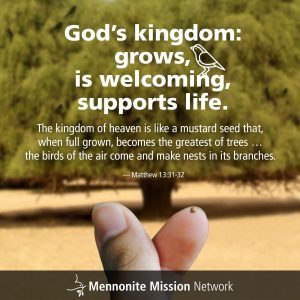
Here the kingdom of God is referred to in small seeds, and growth is not dependent on the sower. No matter what the sower is doing during the growing season, growth happens. When the grain is ripe, the sower is quickly back to work to harvest the grain. This is an important word to anyone involved in leadership or ministry. We do not bring the growth; God does. We also may not see the growth, but we are still called to prepare the soil and plant the seed.
Think of the mustard seed when it grows into a tree. Scripture in Mark says the tree will house birds and provide shade. If you look at a picture of a mustard tree, you will often notice that it does not grow straight and tall, but rather is broad and bushy. It often appears that the branches are tangled with leaves that go every which way. If having faith like a mustard seed is enough, what does having faith like a mustard tree look like?
When faith grows, God is working in individuals; and in the analogy of leaders as farmers, we better be ready to continue the important work of harvest and instruction.
Consider
- Who are the people called to be sowers?
- What does it look like to do the work of planting?
- How do we identify the soil? Or know when the soil is ready for planting?
- What is it we are planting?
- Who is responsible for the growth?
- What does faith look like? Could it be that faith is messy? What examples of a messy faith do you know of?
The Lost Sheep, The Lost Coin
Luke 15:3-10
While it is common for the church today to call Jesus our Good Shepherd, the context in which these parables were being told had a very different view of shepherds. Shepherds in the first century were primarily known as shiftless, thieving, trespassing people. By Rabbis in that day, shepherds were listed among the despised trades right along with camel drivers, sailors, gamblers with dice, dyers, and tax collectors.
This parable challenges the role of leaders who at times did not have the best interest of the flock in mind. The religious leaders in that day were quick to point out who the outcasts were and to designate people as sinners. The Rabbis knew “those people” as outcasts and sinners, and that they would not be included in the kingdom. The Pharisees knew that “those people” broke the moral laws and that they did not maintain the ritual purity that they themselves practiced. Here is the scandal of it all: Jesus received such outcasts, shared meals with them, and even hosted them, showing love and forgiveness that challenged the religious leaders and threatened their status quo.
This parable is an image of Jesus as a loving and caring good shepherd, our shepherd. A “good” shepherd would have been a twist in concept for the Pharisees and religious leaders in that day. Was Jesus comparing them to the outcasts and sinners? Jesus is the good shepherd, and as believers we are called to do as Jesus did. And just who is called to search for the lost?
The silver coin focuses more on what our priorities are. The silver coin was probably a day’s wages, so not a great deal of money, but still so important to the woman. Even though she still had nine silver coins, she searches the house thoroughly to find what was lost.
Finding the lost seems to stir something inside people. In both parables after finding the lost, there is a sharing of the story and a celebration happens. Jesus even said that there is rejoicing for the angels of God when the lost is found.
Neither parable mentions what humans do regarding repentance, but rather focuses on what the righteous must do when the lost is found. Heaven rejoices in finding the lost in all circumstances. Don’t miss the reality that finding the lost is reason for great rejoicing!
Consider
- Who are the outcasts or sinners of today?
- Who is responsible for looking for the lost? For reaching out?
- What is the role of the church when the lost are found?
- What does celebration look like?
The Prodigal Son
Luke 15:11-32
This story focuses on the relationship of the father and the two sons, and we see the two brothers through the father’s eyes.
The son who took an early inheritance comes to understand his dilemma when he is at his lowest. He is without money or possessions and realizes that he is worse off than the hired hands on his father’s farm. Squandering his inheritance that he received from his father is a sin against his father. So, he returns home not expecting to be reinstated as a son, but as a hired hand. It’s a hard lesson to recognize that inheritance without relationship is not all that great.
When the son arrives home, he sees that his father has been waiting and watching for him to return. He is greeted with mercy and treated with love and given possessions and a celebration that he did not deserve. The entire household is called upon to celebrate his return.
The second son, who has been faithfully by his father’s side the whole time, is understandably angry. We can reason that if the younger’s son’s inheritance was already given to him, the possessions his father now has would one day belong to the older son. I can understand why the older son felt that his father was squandering his inheritance on his younger brother. Isn’t it human nature to want what is rightly ours to have?
This parable is complex and full of layers. It’s about individualism and materialism. It’s about relationships. In the end, it is the story of a father who once again has two sons at home. Relationships are reconciled with the father, although it is unclear what will happen to the brothers. We understand that the father, waiting and watching, is God.
At times in our lives we can imagine ourselves as one or the other son. Things seem fair and right when we have enough food or clothes for our family. Or if all our families get along. But what about the other family? Do we care and celebrate when we see reconciliation? Do we throw a party for our neighbors when their son or daughter who was lost comes home? The good news of hope for the world today is that no one is excluded from God’s grace! God desires reconciliation to all people and is eagerly watching for children to come home. Can we celebrate the entire family of God? How willing are we to offer forgiveness and grace to others?
Consider
- What does coming to oneself require?
- Do we build relationships based on money, merit, or mercy?
- Does reconciliation with God require reconciliation with each other?
- What does reconciliation look like?
- As a believer, what do we understand our inheritance to be?

Offering
Your gifts to Mennonite Mission Network make resources like this possible. Join us in sharing the word of God across the street and around the world by giving today. Click here to support our global work.

Worship resources
Worship songs from Voices Together
- No. 300 “Far, Far Away”
- No.799 “The Kingdom of God”
- No. 297 “You are Salt for the Earth”
- No. 545 “Here I am, Lord”
- No. 102 “Santo, Santo, Santo”
- No. 797 “We Are People of God’s Peace”
- No. 477 “Seed, Scattered and Sown”
- No. 563 “Come, Thou Fount”
- No. 113 “O Sing to the Lord”
- No. 420 “God of the Bible”
- No. 765 “Listen, God is calling”
- No. 790 “How Can We Be Silent”
- No. 774 “Lord, You Give the Great Commission”
- No. 584 “Jesus, Be the Center”
- No. 732 “Open My Eyes”

Join in God’s mission

Visit our website for more stories from Mission Network workers and alumni who are, or have served in many places across the globe.

Become a prayer partner. Join a worldwide network of people who support Mission Network through prayer.

Serve with us! Individuals and families may choose from many programs to serve domestically or internationally.

Your gifts to Mennonite Mission Network make resources like this possible. Join us in sharing the word of God across the street and around the world by giving today. Click here to support our global work.

Graphics