
Introduction
The Gospel text in Luke 19:1-10 is a story of mission, showing Jesus on the move, making disciples as he goes (see Matthew 28:16-20). Earlier in Luke, Jesus described himself as “anointed” and “sent” by “the Spirit of the Lord” to “bring good news to the poor” (4:18-19). In Jericho, as he nears completion of his journey to Jerusalem (which began in 9:51), Jesus encounters Zacchaeus, a “chief tax collector” who was “rich.” Will Zacchaeus answer the call to God’s mission from God’s Spirit-anointed Son?
Scripture text
Luke 19:1-10
1 Jesus entered Jericho and was passing through town. 2 A man there named Zacchaeus, a ruler among tax collectors, was rich. 3 He was trying to see who Jesus was, but, being a short man, he couldn’t because of the crowd. 4 So he ran ahead and climbed up a sycamore tree so he could see Jesus, who was about to pass that way. 5 When Jesus came to that spot, he looked up and said, “Zacchaeus, come down at once. I must stay in your home today.” 6 So Zacchaeus came down at once, happy to welcome Jesus.
7 Everyone who saw this grumbled, saying, “He has gone to be the guest of a sinner.”
8 Zacchaeus stopped and said to the Lord, “Look, Lord, I give half of my possessions to the poor. And if I have cheated anyone, I repay them four times as much.”
9 Jesus said to him, “Today, salvation has come to this household because he too is a son of Abraham. 10 The Human One came to seek and save the lost.”
Children’s time
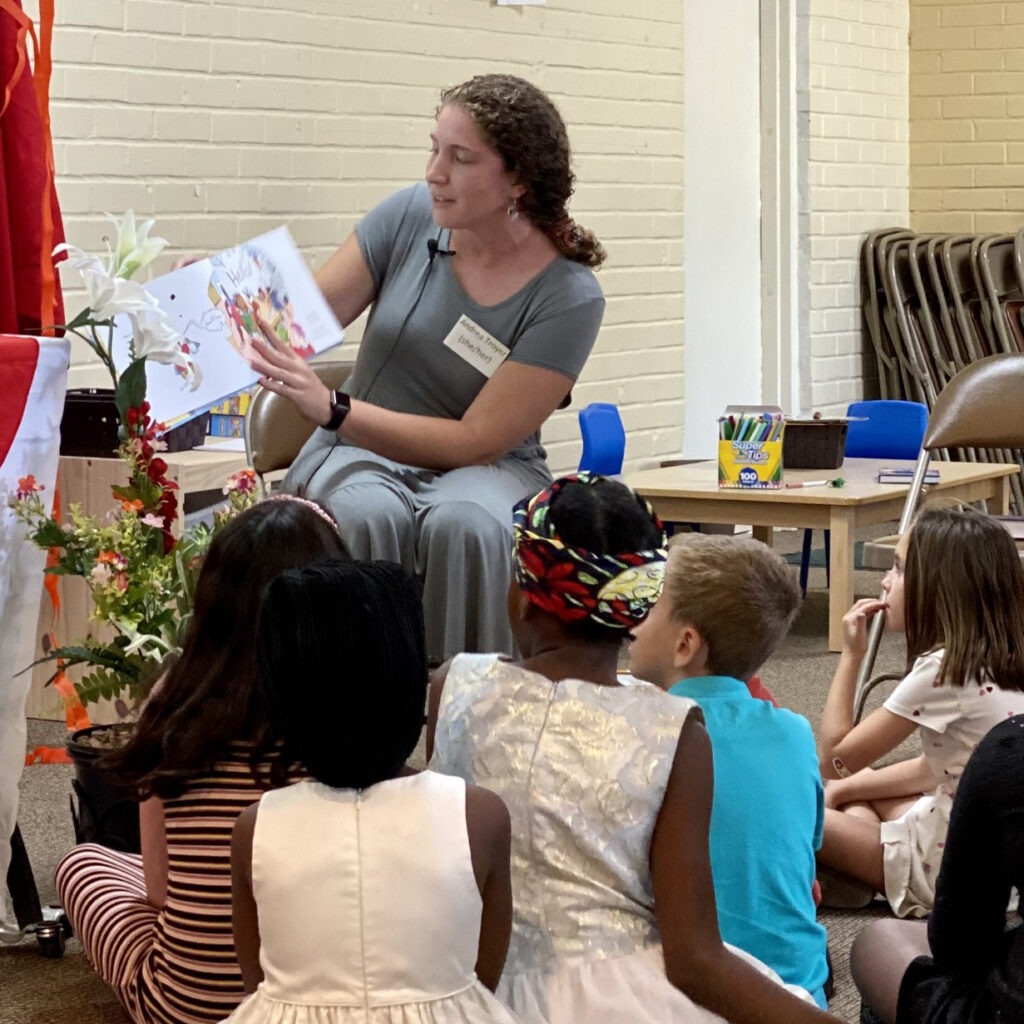
Children’s story
Molo [MO-lo]! My name is Caleb Siwali [KAY- leb See-WA-lee]. I am 8 years old and I live in South Africa. Molo means “hi” in one of the languages I speak. It is the isiXhosa [ee-see-KHO-sa] language. Don’t worry. If you come to South Africa to see me, I also speak English very well.
Have you ever heard of Archbishop Desmond Tutu or President Nelson Mandela? You should learn more about them. They are great men of peace. There are many great men and women of peace in South Africa. My dad and mom are two of them.
My mom, Zandi [ZAN-dee], helps women when they are going through hard times, and my dad, Oscar [OS-ker], started Southern African Development and Reconstruction Agency to help kids and grown-ups learn about how to live in peace.
Peace is not a hard word to say, but peace can be hard to do. When I say “peace,” do you think I’m talking about those little green balls that grow in your garden or come in a tin can? I’m not!
Let me tell you what I know about peace.
- Peace comes when everyone feels special. When I get to school, I say “molo” to each kid. I say their names so no one feels left out. This means I have many friends.
- For people to live in peace, each person must clearly say what they think, in a way that doesn’t hurt other people. When my parents told me we were going to the beach “in a few days’ time,” I asked, “How many days is a ‘few days?’” I was hoping it would be the next day. If I hadn’t asked how many days exactly, there would not have been peace in our house. I would have put on my swimming trunks every morning. Then I would have been disappointed. But I wouldn’t have thrown a tantrum or been demanding.
- That is another thing I know about peace. Shouting or hitting things or people are not ways to build peace. If I shout and hit, I don’t get what I want, and I find that people don’t like to be with me. My dad and mom like to take me shopping because I ask politely if I want a toy or some candy. If my parents say, “Not today,” I respect that.
- Listening helps me understand how another person thinks; when we talk and listen, we can come to a peaceful compromise. A compromise is when each person explains why they want what they ask for, or why they think as they do. For example, sometimes when I am shopping with my mom, I ask for ice cream, but she chooses peas instead. I say, “I don’t like peas. I want ice cream.” She says, “But peas are good for your health and ice cream is bad for your teeth. Ice cream will give you cavities.” So I say, “But peas make me feel sick.”
Can you think of a compromise that will make a happy peace between my mom and me? [Allow children to suggest answers:
- They could buy peas and ice cream. If Caleb eats peas, he can have ice cream and then brush his teeth afterward. This way, he would have healthy food (peas) and happy food (ice cream) and no cavities.
- They could buy a different green vegetable that Caleb likes better than peas.
- They could buy a toy that Caleb wants so he doesn’t feel sad about not getting ice cream.]
I want to practice being a great man of peace, like Jesus and Archbishop Tutu and President Mandela—and my dad. Who do you want to be like?
Uxolo malube nani [Oo-KHO-lo mah-LOO-bay NAH-nee]. Peace be with you.
Prayer
Dear God, show us how to live in peace with each other. Help us to say what we think and listen to others respectfully. Help us to talk to others rather than hitting them or being mean in other ways. Amen.

Sermon starters
Below are four sets of observations and questions on the text that may aid you in the preparation of the message.
1. The story moves through four uses of the verb “to come” in reference to Jesus.
- “Having come in [‘entered’ NRSV], he was passing through Jericho” (19:1).
- “When he came to the place, he looked up …” (19:5).
- “And seeing it, all were grumbling, saying, ‘he came in [‘has gone’] to lodge with a sinful man’” (19:7).
- “For the Son of Man came to seek and to save the lost” (19:10).
Having come in, Jesus was passing through Jericho, as if he did not intend to stay the night. Yet, after coming to the place where Zacchaeus was, Jesus ultimately decides to come in and “lodge” [“be the guest”] in Zacchaeus’s house.
How would you describe the relationship between Jesus “coming to stay” at Zacchaeus’s house and his “coming to seek and to save the lost?”
2. Jesus addresses Zacchaeus in two statements that include the words “today” and “house.”
- “For today it is necessary for me to stay in your house” (v. 5).
- “Today salvation has come to this house …” (v. 9).
In the first statement, Jesus invites himself to Zacchaeus’s house after “looking up” and calling him down from the Sycamore tree, which he had climbed to see Jesus. In the second, Jesus announces salvation to Zacchaeus’s house after Zacchaeus pledges to give “half” his possessions to the poor and “fourfold” to anyone he has cheated in his position as a chief tax collector.
How would you describe the relationship between invitation and salvation in this story?
3. The text refers to Zacchaeus by name three times.
- “And behold [‘there was’] a man, being called by name ‘Zacchaeus,’ and he was a chief tax collector, and he was rich” (v. 2).
- “And having looked up, Jesus said to him, ‘Zacchaeus, hurry and come down …’” (v. 5).
- “But standing, Zacchaeus said to the Lord, ‘Behold [‘Look’], half of my possessions, Lord, I give to the poor …’” (v. 8).
The name Zacchaeus means “pure.”
How would you describe the relationship between the man Zacchaeus and the meaning of his name at the beginning and at the end of this story? How does Zacchaeus respond when Jesus calls him by name?
4. The verb “to seek” occurs twice in this text, each time in the context of personal identity.
- “And he was seeking to see who Jesus is [‘was’]” (v. 3).
- “And he too is a son of Abraham. For the Son of Man came to seek and to save the lost” (vv. 9-10).
In the first case, Zacchaeus is the subject of seeking, while Jesus is the object—the one being sought. Zacchaeus wanted to know the identity of Jesus (“who Jesus was”). In the second case, Jesus is “the Son of Man” who “came to seek and to save” Zacchaeus, the one in whose house he stayed and pronounced salvation. The seeker becomes the sought, and the sought becomes the seeker. Even more, by seeking the identity of Jesus, “the Son of Man,” Zacchaeus is identified by Jesus as “a son of Abraham,” one who receives salvation by grace through faith that works.
How would you describe the meaning of salvation in this text?

Offering
Your gifts to Mennonite Mission Network make resources like this possible. Join us in sharing the word of God across the street and around the world by giving today. Click here to support our global work.

Additional resources
Consider these stories from South Africa as contemporary examples of the processes of grace, repentance, restitution, and reconciliation that we see illustrated in the story of Zacchaeus.
Adriaan Vlok, former Law and Order Minister under the racist system of White-minority rule known as apartheid, has devoted the remaining years of his life to enacting repentance for his sins. See his story in the video “A ruthless defender of apartheid now seeks forgiveness.”
The mothers of the Gugulethu Seven confront Thapelo Mbelo, who, like Zacchaeus, collaborated with an oppressive regime against his own people. Referring to point #3 above, notice how one of the mothers begins her pronouncement of forgiveness with an appeal to Mbelo’s name. The footage is from Long Night’s Journey into Day, an award-winning documentary about the South African Truth and Reconciliation Commission. The video may be rented at vimeo.com/ondemand/longnightsjourneyintoday, or check your local library for a copy. The story of the Gugulethu Seven begins at the 59-minute mark of the film. Warning: Some footage may be disturbing to some viewers.

Worship resources
Worship songs from Voices Together
- No. 417 “Seek Ye First”
- No. 30 “Jesus Calls Us”
- No. 499 “In the Morning When I Rise”
- No. 584 “Jesus, Be the Center”
- No. 388 “How Can I Say”

Join in God’s mission

Visit our website for more stories from Mission Network workers and alumni who are, or have served in many places across the globe.

Become a prayer partner. Join a worldwide network of people who support Mission Network through prayer.

Serve with us! Individuals and families may choose from many programs to serve domestically or internationally.

Your gifts to Mennonite Mission Network make resources like this possible. Join us in sharing the word of God across the street and around the world by giving today. Click here to support our global work.

Graphics